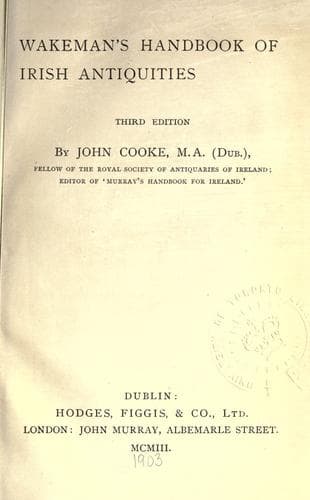
Wakeman's handbook of Irish antiquitiesWakeman, W. F. (William Frederick)
History
Wakeman's handbook of Irish antiquities
Wakeman, W. F. (William Frederick)
Ireland -- Antiquities
* * * * *
_Circle at Newgrange._--It is impossible within the limits of this
Handbook to do more than briefly indicate a few typical examples of
the many stone circles scattered throughout the country. The stones
which encompass the monuments of Newgrange and Dowth are generally very
large, some of them measuring 8 or 9 feet in height. The engraving (p.
123) represents a portion of the circle at the former place, of which a
description has already been given. There are several minor examples in
the same neighbourhood, but they are in a state of great dilapidation,
and, with one exception, would hardly repay a student for the time
occupied in visiting them, particularly as the grander remains at
Newgrange are so accessible.
[Illustration: Remains of Stone Circle near Dowth.]
Portions of a fine circle, or rather oval, lie a little to the east of
Dowth Hall, to the left of the road from Drogheda. Many of the stones
have been removed, but several of gigantic proportions remain in their
original position.
* * * * *
_Circle near Newtownbutler._--One of the most notable circles now
remaining in Ireland is that called the ‘Druid’s Temple,’ situated
on the summit of a hill near Wattle Bridge, a small hamlet in the
vicinity of Newtownbutler, Co. Fermanagh. The stones vary in length
from 3 to upwards of 10 feet. The largest remaining measures slightly
over 10 feet; it is 6 feet 5 inches in breadth, and 3 feet 9 inches in
thickness. Another is 7 feet high, 8 feet 5 inches broad, and 5 feet in
thickness. The circle on the interior measures in diameter 126 feet.
The diameter of the outer ring at Stonehenge is 100 feet, a figure
common to several of these remains.
Whether the Fermanagh circle was ever enclosed by an outer work, as
was common with kindred structures in Britain and elsewhere, can
probably never be ascertained. For more than two hundred years the
land immediately adjoining has been subject to the plough. That there
were outside works, however, can scarcely admit of a doubt. On the
south-east side, a distance of five paces from the circle, are five
large stones, the ruins of a cromlech which had been wrecked many years
ago for the sake of its material.
* * * * *
_Ballynoe (Legamaddy) and Slieve na Greidle Circles._--Interesting
examples of stone circles are to be found in County Down. The largest
is Legamaddy, close to Ballynoe station, about three miles south
of Downpatrick. It consists of inner and outer circles; the former
measures 90 feet by 40 feet, with 22 stones, and the latter 100 feet
in diameter, with 45 stones. Another occurs on Slieve na Greidle, or
Griddle Mountain, to the south-east of the town.
[Illustration: Stone Circle, Ballynoe, near Downpatrick.]
Public-domain text, read in full here on John Shaqi.
Reviews
Reviews
No reviews yet
Be the first to share your thoughts on this work.
Elsewhere in the archive
Join the Discussion
Join the discussion
Sign in to leave a comment or review.
Sign InorCreate an account