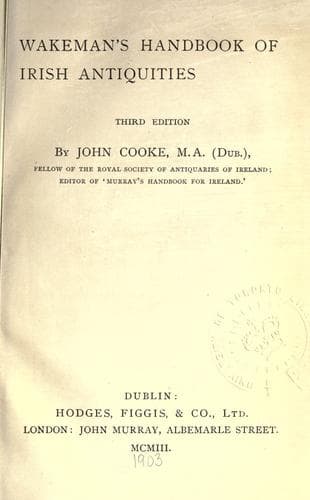
Wakeman's handbook of Irish antiquitiesWakeman, W. F. (William Frederick)
History
Wakeman's handbook of Irish antiquities
Wakeman, W. F. (William Frederick)
Ireland -- Antiquities
The antiquities of Cavancarragh, a district situated on a shoulder
of Toppid Mountain, about four miles from Enniskillen, consist of
two chambered cairns, a stone circle, and what appears to be a small
but well-defined alignment. The latter, and the circle within living
memory, lay buried to a depth of from 8 to 12 feet beneath the surface
of a mountain bog. The alignment consists of a row of stones, four in
number, extending, as far as it can be traced, 480 feet in a direction
very slightly to the north-west and south-east. The blocks average
about 3 feet in height by 2 feet in width, and 6 inches in thickness,
and present the appearance of the ordinary red sandstone flags of the
district. The extreme south-eastern portion of the work has probably
been destroyed; but in that direction the lines could never have
extended much further than they do at present, as the ground suddenly
descends, forming one side of a deep ravine, through which in winter
time a mountain torrent rushes. How far to the north-west the lines
extend is at present uncertain, and cannot be known until the peat in
that direction is further lowered. Probably, however, beyond the circle
no considerable extension would be discovered. The cairns here are in
a very ruinous condition, having for the greater part of a century
served as a quarry for building purposes. The plan of one of them is
very similar to that of the monument at the ‘Barr’ of Fintona already
described. There was no central chamber; and only two of its circle of
cists remain in a good state of preservation. The stone circle standing
near the north-west side of the avenue is 20 feet in diameter, and is
formed of twelve sandstone blocks which at present rise but 2 or 3 feet
above the level of the bog.
There are, however, in Ireland lines of stones, sometimes single,
but never more than double, which should not be confounded with
those strictly of the alignment class. Some of these are the remains
of passages which led to sepulchral chambers, and have been either
stripped of their covering slabs, or were never finished. Such rows may
indeed sometimes be looked upon as portions of ruined cromlechs, or
skeleton traces of monuments like those of the Boyne or Maeshowe.
We find stones of various sizes, differing, as at Finner, near
Ballyshannon, from 1½ feet, or 2 feet 6 inches above ground; or, as
at Breagho and Killee, near Enniskillen, with an elevation of 6 or 7
feet, upon which no definite opinion can be formed as to the class of
monument to which they should be assigned. In all probability they
represent but wrecks of works of a sepulchral kind, which, at a time
now forgotten, but doubtless in modern days, were exhumed during the
process of turf-cutting. Of these, as well as of several other broken
or never completed relics of a megalithic class, found in several parts
of Ireland, it is only certain that they rest on the ‘till’ upon which
peat, to a depth of from 8 to 12 feet or more, once lay.
Public-domain text, read in full here on John Shaqi.
Reviews
Reviews
No reviews yet
Be the first to share your thoughts on this work.
Elsewhere in the archive
Join the Discussion
Join the discussion
Sign in to leave a comment or review.
Sign InorCreate an account