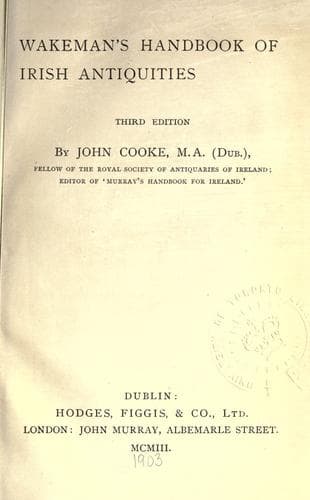
Wakeman's handbook of Irish antiquitiesWakeman, W. F. (William Frederick)
History
Wakeman's handbook of Irish antiquities
Wakeman, W. F. (William Frederick)
Ireland -- Antiquities
[Illustration: Bird’s-eye view of Callernish Circle and Lines.]
One of the most remarkable examples of a stone circle and lines known
in the British Isles is Callernish, on the west coast of the Island of
Lewis. The stones were partially embedded in peat. This was cleared in
1858, and found to exist to a depth of 5 feet. The stones were here
securely sunk in a ‘rough causewayed basement.’ The circle, about 40
feet in diameter, is formed by twelve stones round a central one 17
feet high. Between this stone and the east side of the circle was
found a ruined chambered cairn, 20 feet in diameter, which contained
fragments of burnt human bones. The stones are set in the form of a
cross, the east, south, and west lines single, and extending from the
circle. To the north is a double row or avenue 270 feet long.
There are examples of these lines in the Dartmoor district, with
rows in one case of seven parallel lines. On the Stalldon Moor is a
single line of stones, starting from a stone circle, which can be
clearly traced for one and a half miles, and imperfectly continued for
three-fourths of a mile further, terminating at a kistvaen. Another
perfect line is the Down Tor Stone Row, about 600 yards long, extending
from a circle enclosing a small barrow towards a large cairn.[56]
CHAPTER V.
BURIAL CUSTOMS.--OGAM STONES.
NECESSITY FOR DISPOSAL OF DEAD--INHUMATION AND CREMATION IN BRITISH
ISLES AND CONTINENT--BALLON HILL--CARROWMORE--DYSART--METHODS
OF BURIAL--ORIGIN OF CREMATION--RELIGIOUS SENTIMENT--URNS,
CLASSIFICATION AND USES OF--OGAM STONES--REFERENCE TO,
IN IRISH MSS.--MOUNT CALLAN STONE--BISHOP GRAVES--OGAMS
DESCRIBED--ALPHABET--GENERAL CONSIDERATIONS.
Notwithstanding the number and variety of sepulchral remains in
Ireland, it is strange that the rites and ceremonies attending the
disposal of the dead in prehistoric times have not received from Irish
archæologists the systematic study they deserve. Unfortunately many of
the burial sites have, in the past, been treated in a manner that has
left but little data of any scientific value for expert use. The number
discovered, of cinerary urns containing human remains has been very
great, and establish, beyond a doubt, the fact of the general custom of
cremation. Most of these urns have been destroyed, either through the
ignorance and stupidity of the discoverers, or the carelessness of the
subsequent owners.
Public-domain text, read in full here on John Shaqi.
Reviews
Reviews
No reviews yet
Be the first to share your thoughts on this work.
Elsewhere in the archive
Join the Discussion
Join the discussion
Sign in to leave a comment or review.
Sign InorCreate an account