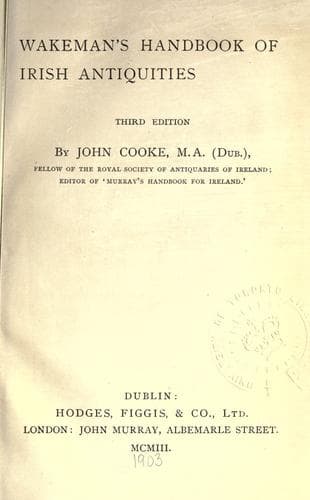
Wakeman's handbook of Irish antiquitiesWakeman, W. F. (William Frederick)
History
Wakeman's handbook of Irish antiquities
Wakeman, W. F. (William Frederick)
Ireland -- Antiquities
The Gauls, as we know from Cæsar, burned some of the servants, slaves,
and favourite animals of the dead chief, or warrior, in celebrating
their funeral rites. Cremation was not practised in Asia Minor,
Phœnicia, or Palestine. The Egyptians embalmed their dead, for they
believed that as long as the body existed, so long did the soul exist
in the spirit world. The Scythians, as Herodotus tells us, did not
burn, but buried their dead. They embalmed the body of their king;
and ‘they strangle and bury with him one of his concubines, his cook,
cup-bearer, groom, lackey, his messenger, and some of his horses,
firstlings of all his other possessions, and some golden cups.’ Over
all was raised a mound; and ‘this Scythian custom, in its late Greek
and Roman imitations, explains the countless tumuli which travellers
see to this day in Bulgaria, in the Dobrudscha, in Wallachia, Moldavia,
and Southern Russia, as far as the Crimea.’[65] The Thracians either
burned or buried their dead, held feasts and games, and raised tumuli.
In Illyria and in Bosnia, as we have stated, inhumation and cremation
were observed at the same time. Historical evidence goes to show that
the Thracians and Illyrians were conquered by the Celtic tribes from
the Alps; ‘and as the culture of the early Iron Age in the Danubian
region corresponds to that of the Celtic Hallstatt, there is a
probability that the practice of cremation, which makes its appearance
in the early Iron Age in Bosnia, and which was practised by some
Thracians in the fifth century B.C., was introduced by the Celtic
conquerors who lived with the Illyrians and Thracian tribes.’[66] Mr.
Ridgeway, having carefully considered the methods of disposing of the
dead in the countries bordering on the Mediterranean, finds that,
without exception, ‘inhumation, or some other method of disposing of
the body without the use of fire, was universal in early times, and
continued so over most of the area down to the Christian era.’ His
conclusion is ‘that cremation did not pass into Greece from either
Libya, Egypt, or Asia Minor, nor did it originate among the Pelasgians
of the islands, nor yet in the mainland.’[67] Whether the practice
arose among the Celtic tribes of Central Europe, or was adopted by
them, it passed with other customs and things westwards and northwards
along the trade routes, and its adoption in Britain and Ireland was
merely a matter of time.
Public-domain text, read in full here on John Shaqi.
Reviews
Reviews
No reviews yet
Be the first to share your thoughts on this work.
Elsewhere in the archive
Join the Discussion
Join the discussion
Sign in to leave a comment or review.
Sign InorCreate an account