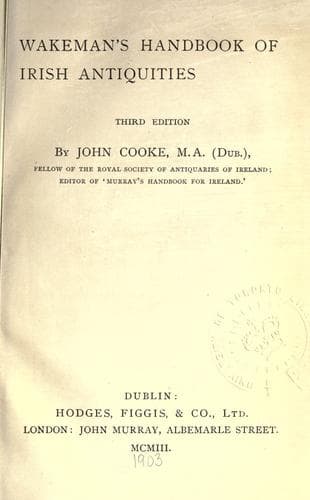
Wakeman's handbook of Irish antiquitiesWakeman, W. F. (William Frederick)
History
Wakeman's handbook of Irish antiquities
Wakeman, W. F. (William Frederick)
Ireland -- Antiquities
Urn burials on a larger scale were found at the Hill of Rath, near
Drogheda, in 1841. Here remains of some 150 to 200 urns were discovered
in an inverted position, each covering a quantity of human bones.
They were placed in the earth without any protection, and were in
consequence mostly broken by the pressure of the earth. Singly and in
small groups urns containing incinerated remains have been found in
most parts of Ireland. Worsaae was of opinion that many of the mounds
or barrows were places of family sepulture, and that cists containing
urns with burial remains found in open fields were those used by the
poorer class who had no burial mound in which to place their dead.[63]
We have ample evidence of the antiquity and general practice of
cremation in Europe. It was the custom of the Achæans, as Homer tells
us, at least 1000 B.C. The remains of Achilles ‘were wash’d in wine
and given fit unction,’ and, with the bones of Patroclus, placed in a
‘two-ear’d bowl of gold.’ This was placed in a grave, and over it was
raised a ‘matchless sepulchre’ high above the Hellespont. The body of
Hector was burned on a mighty pile of wood, and the remains treated
with similar observances. Recent archæological opinion ascribes the
origin of cremation to the Celtic tribes inhabiting Central Europe. It
is urged that the custom would not have arisen among nomadic tribes,
but rather among a people living in a land covered with woods and
forests. Tacitus says that the Germans ‘simply observe the custom of
burning the bodies of illustrious men with certain kinds of wood.
They do not heap garments or spice on the pyre. The arms of the dead
man, and in some cases his horse, are consigned to the fire. A turf
mound forms his tomb. Monuments, with their lofty elaborate splendour,
they reject as oppressive to the dead.’ In Denmark cremation became
a general practice; and in Scandinavia it was an essential religious
custom in the worship of Odin. Professor Montelius thinks that the
evidence favours the view that in the north of Europe the Stone Age
ended rather before than after 1500 B.C. During it the bodies were
always buried unburnt in a recumbent or sitting position, and, as
in the British Isles, urns and implements are found with the burial
remains.[64]
Public-domain text, read in full here on John Shaqi.
Reviews
Reviews
No reviews yet
Be the first to share your thoughts on this work.
Elsewhere in the archive
Join the Discussion
Join the discussion
Sign in to leave a comment or review.
Sign InorCreate an account