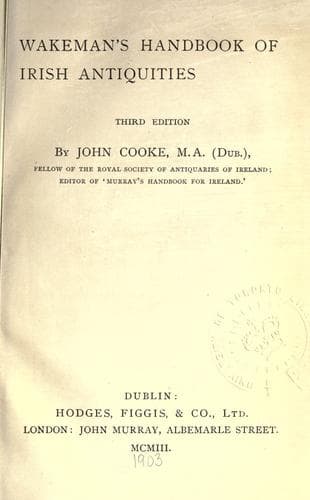
Wakeman's handbook of Irish antiquitiesWakeman, W. F. (William Frederick)
History
Wakeman's handbook of Irish antiquities
Wakeman, W. F. (William Frederick)
Ireland -- Antiquities
_Urns._--As we have seen, urns are among the objects commonly found
with the remains of the dead, whether inhumed or cremated. The Irish
fictilia are usually classified as food-vessels, cinerary urns,
and incense-cups. In Great Britain a fourth class is known, called
‘drinking-cups,’ but none of these have been found among burial remains
in Ireland. The cinerary urns vary in size and ornamentation, and are
found from 10 to 25 inches in height; one of the latter size is in the
Grainger collection in the Belfast Museum. They are usually of narrow
base, and reach their widest above the middle; they contract towards
the mouth, which has an overhanging rim; this is sometimes broad enough
to contain all the ornamentation on the urn. This consists of chevron,
lozenge, or other archaic designs impressed into the clay. A good many
of the richer description present mouldings, bosses, &c., in relief.
It is difficult to form an exact opinion as to the manner in which the
more highly decorated and larger urns were manufactured. They generally
present an outer surface, some eighth or so of an inch in depth,
composed apparently of well-kneaded compost of yellow or buff-coloured
clay, which exhibits but few or no traces of the action of fire.
Underneath this envelope is a black, highly-fused mass of coarser
composition, which forms what may be called the strength of the vessel.
It is a curious fact that the majority of cinerary vases exhibit upon
the interior indications of an intense action of fire, while in many
examples the outer surface would seem to be simply sun-baked. From a
careful examination of a considerable number of urns found in Irish
tumuli and sandhills, it seems to us that at least three stages in the
process of their formation are indicated. First, the vessel appears
to have been fashioned of a somewhat coarse, gritty material; it was
then baked in a strong fire, and burnt almost to blackness. It would
seem, upon cooling, to have been overlaid with a fine matter, generally
buff or cream-coloured, sufficiently soft to receive impressions
readily from a tool formed of wood, horn, bone, stone, or possibly of
bronze or iron. Strips of light material, like that of the coating
or veneer already referred to, were then laid on, just, to use a
homely illustration, as a modern cook will embellish a pie-crust. The
overlayings, while still soft, were then indented with patterns, and
the work either dried in the sun or presented to the influence of a
moderate degree of heat from a fire of wood or peat.
[Illustration: Cinerary Urn from Co. Carlow.]
[Illustration: Cinerary Urn, Co. Wicklow.]
[Illustration: Cinerary Urn, Co. Cavan.]
Public-domain text, read in full here on John Shaqi.
Reviews
Reviews
No reviews yet
Be the first to share your thoughts on this work.
Elsewhere in the archive
Join the Discussion
Join the discussion
Sign in to leave a comment or review.
Sign InorCreate an account