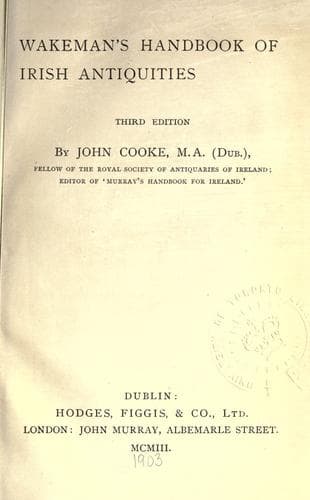
Wakeman's handbook of Irish antiquitiesWakeman, W. F. (William Frederick)
History
Wakeman's handbook of Irish antiquities
Wakeman, W. F. (William Frederick)
Ireland -- Antiquities
All sepulchral urns were hand-made and invariably unglazed. They have
been found to contain portions of the bones of a human body, sometimes
of more than one, in a highly calcined state; and there is reason to
believe that occasionally some relics, also burnt, most notably those
of the dog, had been inurned along with the remains of man. Arrow-heads
and knives of flint, pins of bone or bronze, glass and stone beads,
rings of jet, and in one case, at least, a beautiful knife or dagger of
bronze, have formed, with the bones, portion of the contents of these
vessels; charcoal and particles of half-consumed wood constitute the
remainder. Sometimes the urn is found placed mouth downward, and, as
at Drumnakilly, surmounting a cup-hollow; but in general it stands on
its base, and is covered by a thin flat stone or slate. A unique and
very beautiful example, preserved in the National Museum, is furnished
with a veritable lid. Though generally presenting the appearance of a
cinerary urn, this relic may have been a food-vessel.
[Illustration: Urns from Co. Down.]
The vessels considered to have been receptacles for food are usually
found associated with inhumation, and are supposed to have contained
food for the spirits in their journey to the world of shades. Though
they vary greatly in ornamentation, yet they are better made and more
richly decorated than the British urns of a similar class. They are
somewhat globular in form, and are well represented in the figure on
next page, which shows a specimen discovered in connection with the
cromlech-like tomb in the Phœnix Park, already described. This vessel,
with some antiquities of the same ‘find,’ may be seen in the National
Museum. One other example (p. 149), remarkable for the elaborate
character of its ornamentation, is from Ballymote, County Sligo.
[Illustration: Food-Vessel from Cist in the Phœnix Park, Dublin.]
[Illustration: Small Cinerary Urn, Bagenalstown, Co. Carlow.]
[Illustration: Food-Vessel from Grave near Ballymote, Co. Sligo.]
Public-domain text, read in full here on John Shaqi.
Reviews
Reviews
No reviews yet
Be the first to share your thoughts on this work.
Elsewhere in the archive
Join the Discussion
Join the discussion
Sign in to leave a comment or review.
Sign InorCreate an account