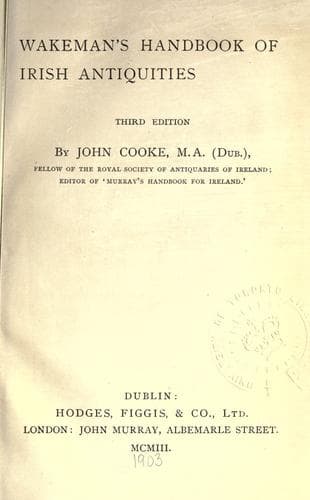
Wakeman's handbook of Irish antiquitiesWakeman, W. F. (William Frederick)
History
Wakeman's handbook of Irish antiquities
Wakeman, W. F. (William Frederick)
Ireland -- Antiquities
The so-called ‘Incense Cups’ found in Ireland are, like their
British prototypes, invariably of very small size. They are usually
undecorated; the rims are sometimes pierced with four or more
apertures, as if for suspension. In Ireland vessels of this kind are
usually found enclosed in urns of the larger and richer class. There
is no evidence to support the theory that they were used as vessels for
holding ‘incense,’ or as ‘chafers’ containing burning coals for a short
time. They are now generally considered as cinerary urns in which the
remains of infants were placed. Perhaps the most beautiful specimen yet
discovered in the British Isles was found near Bagenalstown in 1847,
which contained the burnt bones of an infant or very young child. ‘It
was embedded in a much larger and ruder urn, filled with fragments
of adult human bones.’ The smaller urn, when reversed, ‘presents,’
says Wilde, ‘both in shape and ornamentation all the characteristics
of the Echinus, so strongly marked that one is led to believe the
artist took the shell of that animal for his model.’ It is 2⅛ inches
high, and 3¾ across the outer margin of the lip, which is beautifully
ornamented, and has the rare addition of a handle. The body is divided
into a number of upright sections, all elaborately worked in a
variety of patterns. A rope-like ornament surrounds the neck, and the
under-portion of the lip has an accurately cut chevron.
OGAM STONES.
The passage we have quoted from the _Book of Ballymote_ (p. 142) is
one of many from Irish MSS. which refer to Ogam Stones. In the account
in the _Leabhar na h-Uidhre_ of the death and burial of Fothadh
Airgthech, who was killed in the Battle of Ollarba, near Larne, in 285
A.D., we are told of his burial in a stone sepulchre with ‘his two
Fails (bracelets), his Bunne-do-At (twisted hoop), and his Muintorc
(neck-torque) of silver; and there is a rock standing at his tomb; and
there is an Ogam inscription on the end which is in the ground of the
rock, and what is written on it is: Eochaidh (or Fothadh) Airgthech
is here.’[73] In the _Táin Bó Chuailgne_ (the Cattle raid of Cooley),
the earliest copy of which is to be found in the _Book of Leinster_,
we read that when Fergus mac Roigh brought back the body of Fergus
Etercomal, who was slain by Cuchulainn, they celebrated his funeral
games, planted a stone over his grave, and inscribed his name in Ogam.
In an early poem in the _Book of Leinster_ we have, in an account of
the Battle of Gabhra, which was fought in 283 A.D., the following
lines referring to the death of Cairbre Lifeachair:--
‘An Ogam in a _lia_, a _lia_ over a _leacht_,
In a place whither men went to battle,
The son of the king of Erin fell there,
Slain on his white steed by a sharp spear....
‘That Ogam which is upon the stone,
Around which the heavy hosts have fallen
If the battle-fighting Finn had lived,
Long would that Ogam be remembered.’
Public-domain text, read in full here on John Shaqi.
Reviews
Reviews
No reviews yet
Be the first to share your thoughts on this work.
Elsewhere in the archive
Join the Discussion
Join the discussion
Sign in to leave a comment or review.
Sign InorCreate an account