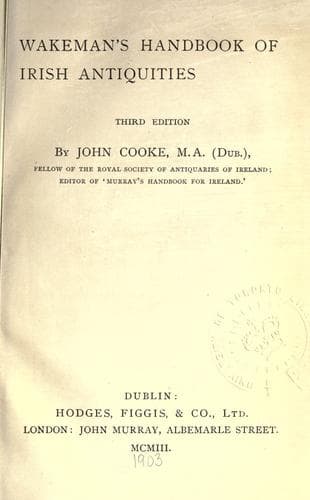
Wakeman's handbook of Irish antiquitiesWakeman, W. F. (William Frederick)
History
Wakeman's handbook of Irish antiquities
Wakeman, W. F. (William Frederick)
Ireland -- Antiquities
The Ogam character was sometimes used in other material than that of
stone. There is MS. evidence, as we have mentioned, of its having
been applied to wood, which was doubtless the material first used for
the purpose; and examples occur in bone, amber, gold, silver, and
lead. Of these are the Conyngham gold manilla, the authenticity of
the characters of which was, however, doubted by Dr. Graves; a silver
brooch found in 1806 at Ballyspellan (Co. Kilkenny), and which is
considered to date from the end of the eleventh or beginning of the
twelfth century. The specimen in lead was discovered by Mr. Wakeman
in 1844; the little vessel upon which the scores appeared was then
in use as an ink-bottle. It is interesting not only from the legend
being in relief, which goes to establish its genuineness, but also from
the circumstance of its discovery in Kilmallock, the name of which
place it gives. The characters are in two lines, and, if read from the
bottom upwards, give the words: ‘Nig-Lasmeich,’ and ‘Cill Mocholmog.’
The object on which they occur is a narrow, quadrangular vessel, one
inch and three-eighths in height, with sides converging upwards, and
with a low, small, circular neck. The Ogam character, in one form or
another, was sometimes used as a charm, as in the case of the amber
bead belonging to a family of the O’Connors, near Ennis, Co. Clare; or,
as shown by Bishop Graves, for purposes of divination.
Archæologists are not yet agreed on all matters relating to Ogams. The
varied opinions as to the readings of most inscriptions, the somewhat
uninteresting and meagre details of all, the doubt hitherto as to
whether they are cryptic or not, the great difficulty of identifying
them through the medium of Irish written records, limit the interest
and check inquiry in this particular field of archæological research.
But Dr. Stokes and Dr. Rhys have established their non-cryptic
character, and shown their exceptional value from a philological point
of view. Doubt, too, has long been thrown on their antiquity. Brash and
others claim for them a pre-Christian origin; but recent authorities,
such as Dr. Rhys, do not consider them earlier than the introduction of
Christianity into the British Isles. It has been well urged by Bishop
Graves that the division of the alphabet into vowels and consonants
‘furnishes internal evidence of its having been contrived by persons
possessing some grammatical knowledge, and acquainted with alphabets
of the ordinary kind.’ Other questions arise, such as the presence of
the Christian emblem on many stones, the number standing in church
burial-grounds, and their presence in caves, from which various
deductions have been drawn. It has been urged by the claimants for the
pagan origin of Ogams, that it was the custom of the early missionaries
to convert things identified with heathen uses to Christian purposes,
and to mark such objects as these stones with the sacred symbol of the
Cross.
Public-domain text, read in full here on John Shaqi.
Reviews
Reviews
No reviews yet
Be the first to share your thoughts on this work.
Elsewhere in the archive
Join the Discussion
Join the discussion
Sign in to leave a comment or review.
Sign InorCreate an account