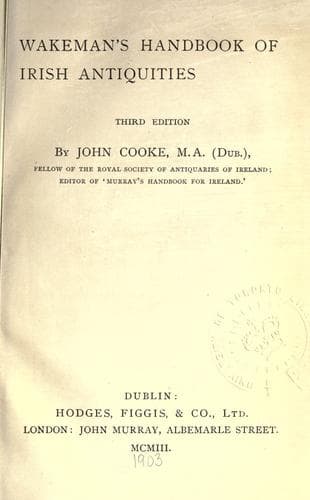
Wakeman's handbook of Irish antiquitiesWakeman, W. F. (William Frederick)
History
Wakeman's handbook of Irish antiquities
Wakeman, W. F. (William Frederick)
Ireland -- Antiquities
A consideration of these questions would lead us too far afield,
and not necessarily lead to a final judgment on any of the points at
issue. It is sufficient, however, to say that the internal evidence
of the alphabet, and the affinity of the Irish unilingual Ogams to
the bilingual stones of Wales, are in themselves highly presumptive
of their dating within, and not without, the period marking the
establishment of Christianity in Ireland.
CHAPTER VI.
RATHS AND STONE FORTS.
RATHS AND DUNS--SUBTERRANEAN CHAMBERS--SOUTERRAIN IN GURTEEN
RATH--TARA--EMANIA--RATH OF DOWNPATRICK--HILL OF WARD--NAAS
RATH--CASHELS--CLOCHAUNS OR BEE-HIVE HUTS--STAIGUE FORT--
CAHERCONREE--CLARE FORTS--DUN AENGUS--THE DINGLE FORTS AND
CLOCHAUNS--DUNAMOE--INISMURRAY--GRIANAN OF AILEACH--GENERAL
CONSIDERATIONS.
The wooden huts or wicker and clay dwellings of the primitive
inhabitants of Ireland were quick to decay; but the raths, lisses,
duns, and cashels, the remains of their camps and fortresses, exist
all over the country, dotting many a plain or valley, and crowning
many a hill. Whatever distinction originally existed between the terms
_rath_ and _Lios_ or _Lis_, they are now commonly applied to fortified
dwelling-places. Though they were generally used to signify the earthen
rampart round the enclosure on which the dwellings were built, ‘both
are,’ says Dr. Joyce, ‘not unfrequently applied to the great high
entrenched mounds which are commonly designated by the word _Dun_.’[75]
* * * * *
_Raths and Duns._--Notwithstanding the destructive agencies of time,
and especially the reclamation and enclosure of land, the number of
raths still remaining is very great. The Ordnance Survey showed 10,000
in Munster, Limerick having 2191,[76] and the number for the whole of
Ireland may be taken from 28,000 to 30,000. Dr. Joyce states that the
term _Rath_ enters into the name of 700 townlands, and _Lis_ into 1400
townlands and villages. That so many of these structures remain, is due
largely to the fact that the peasantry have a superstitious reverence
for these ‘forts’ as the home of the ‘good people’ or fairies. They
are also popularly attributed to the Danes; but their very number and
distribution, and the fact that the Danes never established themselves
beyond the east and south-east coast of Ireland, are sufficient,
without mentioning other considerations, to show that the Danes had
nothing to do with their erection. Fort-building covered a long period
of time; and at whatever remote date it commenced, there is evidence to
show that the forts were built and restored for many centuries after
the introduction of Christianity into Ireland.
Public-domain text, read in full here on John Shaqi.
Reviews
Reviews
No reviews yet
Be the first to share your thoughts on this work.
Elsewhere in the archive
Join the Discussion
Join the discussion
Sign in to leave a comment or review.
Sign InorCreate an account