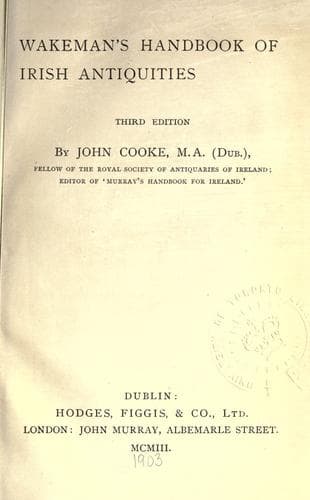
Wakeman's handbook of Irish antiquitiesWakeman, W. F. (William Frederick)
History
Wakeman's handbook of Irish antiquities
Wakeman, W. F. (William Frederick)
Ireland -- Antiquities
_Souterrains._--Within the inner rampart, but not in the raised
mound as far as we have examined, underground passages and chambers
varying in plan have been discovered. These earth-houses, to which the
term _Souterrain_ is now usually applied, are generally similar in
structure to the sepulchral chambers already described, the passages
being lined and covered with stones, and the chambers of a bee-hive
shape, formed by overlapping courses. Where the earth was sufficiently
compact the excavation was sometimes made practically without the aid
of stone, which was used only in forming the entrance. It is evident
from the intricate nature of these underground structures, and the
readiness with which they could be defended from attack, that they were
designed as places of safety. They were probably used both as places
of temporary retreat and as storehouses, the want of ventilation, save
that derived from the narrow external entrance, rendering them unfit
for continued habitation. Tacitus says the Germans dug underground
dwellings: ‘These they use as winter retreats and granaries, for they
preserve a moderate temperature; and upon an invasion, when the open
country is plundered, these recesses remain inviolated, either because
the enemy is ignorant of them, or because he will not trouble himself
with the search.’
An examination of the kitchen-middens of some of these raths produced
the ordinary ‘finds’ of primitive dwellings, stone, flint, and bone
weapons and implements, the bones of animals used for food, fragments
of pottery, bronze and iron objects. The Whitechurch rath, examined
by Mr. R. J. Ussher, yielded a variety of these, including many iron
objects, which showed that its occupation probably covered a long
period of time. The rath had been deeply excavated to form the chambers
and an extensive system of connecting galleries.[78] Souterrains are
found apart from raths in isolated places in many parts of Ireland.
They are very similar to those found in Scotland, where they are known
as ‘eirde houses,’ ‘weems,’ or ‘Picts’ houses,’ and also to those found
in Cornwall, which seems to point to a common origin for all. ‘The only
slight difference between the Irish and the Scotch,’ says Dr. Munro,
‘is in the extent of curvature of the main gallery, which appears to be
less pronounced in the Irish souterrains.’ He also points out that they
differ in being so often found in connection with raths, as among the
Scotch examples ‘only one instance is known inside a fort--viz., that
in the ancient fort known as Macbeth’s Castle on Dunsinane Hill.’[79]
Underground dwellings have been used by primitive races everywhere--in
Asia, Africa, and America, as many travellers testify.
Public-domain text, read in full here on John Shaqi.
Reviews
Reviews
No reviews yet
Be the first to share your thoughts on this work.
Elsewhere in the archive
Join the Discussion
Join the discussion
Sign in to leave a comment or review.
Sign InorCreate an account