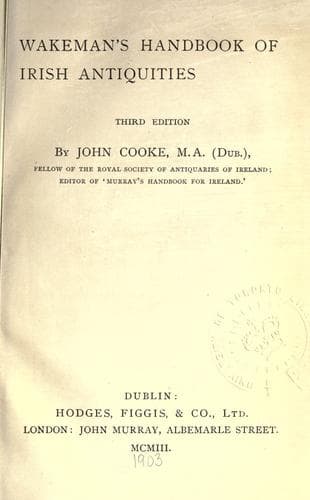
Wakeman's handbook of Irish antiquitiesWakeman, W. F. (William Frederick)
History
Wakeman's handbook of Irish antiquities
Wakeman, W. F. (William Frederick)
Ireland -- Antiquities
The general plan is circular and the construction simple. A deep ditch
or trench was dug and the earth thrown up, forming a steep enclosing
dyke or rampart, which was probably rendered further secure by a stake
fence. They vary in size from a few yards to a hundred in diameter, and
often consist merely of the circular entrenchment, the area of which
is slightly raised above the level of the adjoining land. These are
common in the central parts of Ireland, such as the motes of Granard,
Slane, and Clones. But in the case of many of the more important they
were enclosed by two, three, or more breastworks; and within the inner
rampart stood a steep mound, flat at the top, on which was erected the
house of the king or chief, overlooking the camp. On the verge of steep
cliffs, or rocky headlands jutting into the sea, and on the summit
of inland hills, these defences were generally erected. Sites were
chosen whose natural features afforded a ready means of rendering the
positions secure. The term _Dun_ is usually applied to this class of
fortification, and it enters into the composition of many place-names,
Dr. Joyce stating that it is used as a prefix to 600 townlands.
Alignments of forts are an important feature in Ireland, and will be
found especially on the sea-coast from Waterford, westwards, and round
to the north of Mayo, and also in many inland districts. Perhaps the
largest earthwork in Ireland is the Dun at Dorsey, County Armagh. It
is about one mile long and 600 yards wide, and consists of a great
embankment with a fosse on each side and outer ramparts. Portions still
remain sufficient to show the magnitude of this great earthwork when
originally constructed.[77]
* * * * *
Public-domain text, read in full here on John Shaqi.
Reviews
Reviews
No reviews yet
Be the first to share your thoughts on this work.
Elsewhere in the archive
Join the Discussion
Join the discussion
Sign in to leave a comment or review.
Sign InorCreate an account