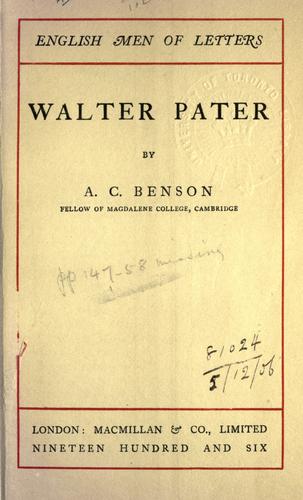
Authors, English -- 19th century -- Biography; Critics -- Great Britain -- Biography; Pater, Walter, 1839-1894
After this impulse, if it was ever so much as an impulse, died away, he
seems to have been content for some years to suspend his judgment. He
even, both in public and in private, used expressions which indicated
an attitude of definite hostility to the Christian position. He was
immersed in artistic conceptions, and in practical work; but as he
grew older the old associations began to reassert themselves; he
found, like so many people of speculative temperament, who set out on
a philosophical quest with an impatience of received traditions and
conventional opinion, that there was far more truth in the accumulated
treasures of human thought, simple and in many ways contradictory as
they appeared, than he had originally believed. As he wrote once, in
one of his reviews for the _Guardian_, “the religious, the Catholic,
ideal, ... the only mode of poetry realisable by the poor.”
He discovered afresh the tranquillising influence of a direct faith on
quiet people—of the type that he described in another review; speaking
of sacristans as “simple people coming and going there, devout, or
at least on devout business, with half-pitched voices, not without
touches of kindly humour, in what seems to express like a picture
the most genial side, midway between the altar and the home, of the
ecclesiastical life.” And thus the old quiet consecration of life by
faith, not very confident perhaps, hardly more than a sacred hope of
beautiful and tender possibilities, reasserted itself.
As Lady Dilke wrote of a talk with him in the later years:—
“Pater came and sate with me till dinner-time. We had been talking
before that on the exclusive cultivation of the memory in modern
teaching as tending to destroy the power of thought, by sacrificing
the attitude of meditation to that of perpetual apprehension. When
the others left we went on talking of the same matter, but on
different lines. Thence we came to how it might be possible, under
present conditions of belief, to bring people up not as beasts but
as men by the endeavour to train feeling and impart sentiments as
well as information. He looks for an accession of strength to the
Roman Church, and thinks that if it would abandon its folly in
political and social intrigue, and take up the attitude of a purely
spiritual power, it would be, if not the best thing that could
happen, at any rate better than the selfish vulgarity of the finite
aims and ends which stand in the place of an ideal in most lives
now. He has changed a great deal, as I should think for the better,
and is a stronger man.”
Pater spoke, indeed, as I conceive, very plainly in one place—the
review of _Robert Elsmere_—of what was the inner attitude of his
mind:—
Public-domain text, read in full here on John Shaqi.
Reviews
Reviews
No reviews yet
Be the first to share your thoughts on this work.
Elsewhere in the archive
Join the Discussion
Join the discussion
Sign in to leave a comment or review.
Sign InorCreate an account