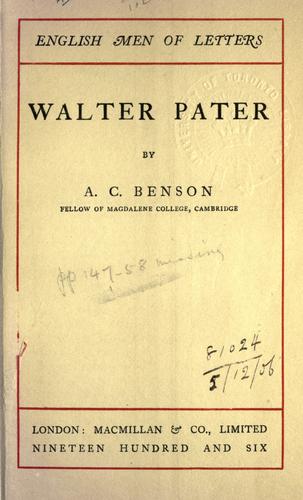
Authors, English -- 19th century -- Biography; Critics -- Great Britain -- Biography; Pater, Walter, 1839-1894
region, in which the lower impulse is entirely inconsistent with the
grave appreciation of beauty.
In the aesthetic movement, Pater concerned himself solely with
the doctrine; but at the same time it is undeniably true that the
leaders of a movement are always judged by the extravagances of their
followers; and the anxiety and even suspicion with which Pater’s
views were at one time regarded in Oxford, were due to the fact that
those with whom he was in a certain sense in sympathy on the higher
aesthetic grounds, applied the doctrine of beauty to a recklessness of
practice which Pater not only condemned, but the contemplation of which
both disgusted and appalled him. It is better to have no misconception
on this point. It is as unfair to think of Pater as in sympathy with
the decadent school, as it is to attribute to the original teachers
of Predestination the immoral distortion of the doctrines which
disgraced some of their fanatical sectaries. When the whole movement
has, so to speak, shaken down; when we can look dispassionately at the
part which the aesthetic school has played in the mental development
of the age, we shall be able, while we condemn whole-heartedly the
excesses of the advanced disciples, to discern the part that Pater and
the other leaders of the movement played in setting the deliberate
appreciation of beauty, the sedulous training of the perceptions in the
discrimination of the subtle effects of impassioned art, in its right
place among the forces which tend to the ennobling of human character
and temperament.
Having thus drawn out, as far as possible, what Pater’s ethical
creed was not, let us try to indicate the nature and movement of
his religious life. He began, it is plain, by feeling the strong
aesthetic attraction of the accessories of religion; probably he did
not disentangle the elements of religious faith from the effect which
great churches, solemn ceremonial, ecclesiastical music, and hieratic
pomp had upon his mind. As Jowett is once, in early days, reported to
have said to him somewhat irritably, at the close of a discussion,
“Mr. Pater, you seem to think that religion is all idolatry!” But as
soon as Pater plunged into the study of metaphysics, he found that
philosophy began to act as a solvent upon his creed; he still had a
bias towards the expression of religious truth; and his half-formed
idea of becoming a Unitarian minister, which, as I have said, was
suggested in all probability by the career of Coleridge, was the
outcome of this mood.
Public-domain text, read in full here on John Shaqi.
Reviews
Reviews
No reviews yet
Be the first to share your thoughts on this work.
Elsewhere in the archive
Join the Discussion
Join the discussion
Sign in to leave a comment or review.
Sign InorCreate an account