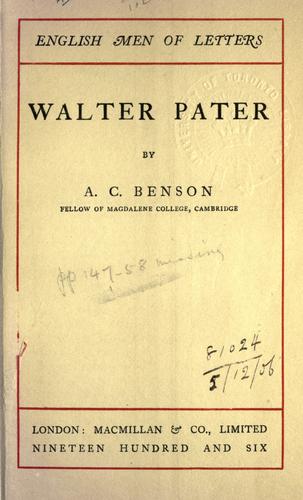
Authors, English -- 19th century -- Biography; Critics -- Great Britain -- Biography; Pater, Walter, 1839-1894
The work of writing grew easier to him as time went on. “Ah! it is much
easier now,” he said to Mr. Gosse, near the end of his life. “If I live
long enough, no doubt I shall learn quite to like writing.”
He was a regular rather than a hard worker. It was his habit for many
years to devote two or three hours of the morning to writing, and he
often wrote again for another hour in the afternoon. But he never
worked late at night; writing was to him an absorbing and at the same
time a fatiguing process, to be pursued temperately and quietly. Some
writers work for a time as though possessed, fall into a profound
exhaustion when a book is finished, and then lie fallow for a time.
Such was never Pater’s way. His writing was his central concern; he
loved it with an ever-growing love; it formed the staple employment of
his days; but his friends say that there never was a man who seemed to
be always so free from preoccupation, so ready to put his work aside,
and enter into conversation of the most trivial kind; there were no
furtive glances at the clock, none of the air of jealous if patient
resignation, no hunted sense of the desire to escape from interruption.
Again, too much emphasis has been laid upon the conscious fatigue
and exhaustion arising from his work. He was not, like Flaubert, the
racked and tortured medium of his thought. He was a man of low physical
vitality, and he would sometimes half-humorously lament the labour
that his work cost him. But the toil and the delight were inextricably
intermingled; such writing as Pater’s with its subtle distinctions,
its fine metaphors, its delicate effects, its haunted richness, its
remote images, its liquid cadences, could never have been produced
except by one who tasted to the full the artistic pleasure of elaborate
workmanship. And it is beyond all doubt that his work became to him in
increasing measure the mainspring of his life, a spring of the purest
joy.
One source of his concentrated strength was that he never wasted time
in experimental researches; he knew his own mind; he knew exactly what
interested him and the limitations of his taste; thus he confined his
ideals to a restricted circle, and though perhaps losing somewhat in
catholicity of thought, he gained astonishing depth and insight in
certain specified directions. But he made no parade of omniscience.
He used to say smilingly that it was such a relief to work hard at a
subject and then forget all about it.
Public-domain text, read in full here on John Shaqi.
Reviews
Reviews
No reviews yet
Be the first to share your thoughts on this work.
Elsewhere in the archive
Join the Discussion
Join the discussion
Sign in to leave a comment or review.
Sign InorCreate an account