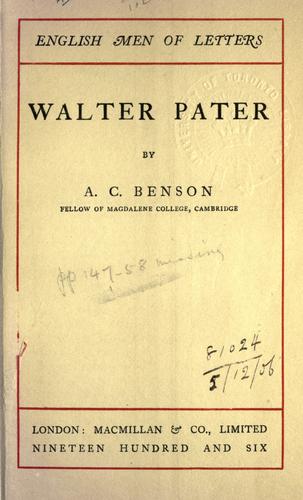
Authors, English -- 19th century -- Biography; Critics -- Great Britain -- Biography; Pater, Walter, 1839-1894
One of Pater’s happiest accomplishments was his power of bringing up
in a few words a figure or a scene, beautiful in itself and charged
moreover with a further and remote significance, revealing as by
a sudden glimpse or hint some solemn thought enshrined within the
outer form. Thus he said once that churches where the Sacrament was
reserved gave one the sense of a house where a dead friend lies; and
again in a subtle allegory he touched the difference between Roman
Catholicism with all its rich fabric of association and tradition,
and Puritanism with its naked insistence on bare rectitude and rigid
conduct. Roman Catholicism, he said, was like a table draped in fair
linen, covered with lights and flowers and vessels of crystal and
silver; while Puritanism was like the same table, after it had been
cleared, serviceable enough, but without charm or grace. The essential
form present in both; but the one furnished with rich and dainty
accessories, the other unadorned and plain.
It may be said generally that richness under a severe restraint is the
principal characteristic of Pater’s style; but there are two or three
special small characteristics, almost amounting to mannerisms, which
may be noted in his writing. One is the natural result of his habit of
composition; it is of overloading his sentences, of introducing long
parentheses, of heaping fine detail together, which sometimes gives an
impression of over-luxuriousness. Here is a typical sentence, out of
one of the _Guardian Essays_, the review of Wordsworth:—
“An emanation, a particular spirit, belonged not to the moving
leaves or water only, but to the distant peak arising suddenly, by
some change of perspective, above the nearer horizon of the hills,
to the passing space of light across the plain, to the lichened
Druidic stone even, for a certain weird fellowship in it with the
moods of men.”
This sentence has every charm except the charm of perfect lucidity. But
any one who enjoys the characteristic quality of Pater, will be able to
give its due value to the slight blurring of outline on which the charm
to a certain extent depends.
Again, he was fond of beginning a sentence with the emphatic phrase,
and thus inverting the clause. Where another writer would say, “That
tale of hours, the long chanted English service, develops patience,”
Pater wrote: “It develops patience—that tale of hours, the long
chanted English service.” And again: “Horace!—he was, had been always,
the idol of their school.” And again: “Submissiveness!—It had the
force of genius with Emerald Uthwart.” Such sentences, occurring as
a rule at the opening of a paragraph, are of constant occurrence. He
had a fondness for points of exclamation: “How wretched! how fine! how
inconceivably great and difficult!—not for him!” and his frequent
introduction of the word “say!” with its stop breaking the continuity
of the clause where an ordinary writer would use “for instance,” is a
favourite usage.
Public-domain text, read in full here on John Shaqi.
Reviews
Reviews
No reviews yet
Be the first to share your thoughts on this work.
Elsewhere in the archive
Join the Discussion
Join the discussion
Sign in to leave a comment or review.
Sign InorCreate an account