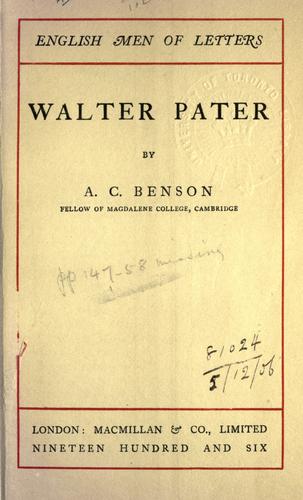
Authors, English -- 19th century -- Biography; Critics -- Great Britain -- Biography; Pater, Walter, 1839-1894
to nature, not in the spirit of Wordsworth, to exult in the freedom,
the width, the tenderness, the energy, the vastness of it all; but
rather as a great quarry of impressions, through which he walked with
a perceptive gaze, selecting and detaching striking and charming
effects, which could afterwards be renewed and meditated over in the
home-keeping mind. None of his direct nature-touches, beautiful as
they are, are penetrated with quite the same zest and emotion as his
descriptions of nature when represented by some master-hand. It was the
penetration of nature by human personality that gave it its value for
Pater, its significance; and thus it comes about that his descriptions
of scenes always seem, so to speak, to have a frame about them. He did
not, like a poet, desire to escape from man to nature; but rather to
suffuse nature at every point with humanity, to judge of it, to feel
its beauty, not as the direct expression of the mind of God, but as it
affected and appealed to man.
It might have been imagined that so deliberate and precise a craftsman,
with so definite a theory of his art, would perhaps have held on his
way producing his careful masterpieces, content to put it on record
that he had thought thus, and expressed it just so, content that the
beautiful thing should be formed and fashioned, and made available for
the use or delight of any that followed the same or a like path among
the things of the soul. One could have supposed Pater indifferent to
criticism and censure, deeming it enough not to be unfaithful to the
heavenly vision. For to him, doubtless, the first and chiefest pleasure
lay in the thrilling thought, that thought which sets the writer’s
spirit all aglow, leaping into the mind, as it does, with an almost
physical shock, and opening up a sudden vista of possibilities; as
when a man, walking in a wood, comes suddenly across a ride, and sees
the green space run to left and right, with its carpet of flowers, its
leafy walls. And next to that first and sacred joy came the delight of
the slow and careful conception, tracing the development, restricting
the ramification, foreseeing the proportion. Then followed the later
joy, the gradual embroidery of the austere outline, the laying of
thread by thread, of colour by colour; and then the final pleasure of
strict revision, of enriching the close texture, of strengthening the
languid cadence, of refining the refined epithet, the eagerness to
reach that impossible perfection that seemed to recede even as he drew
near.
Public-domain text, read in full here on John Shaqi.
Reviews
Reviews
No reviews yet
Be the first to share your thoughts on this work.
Elsewhere in the archive
Join the Discussion
Join the discussion
Sign in to leave a comment or review.
Sign InorCreate an account