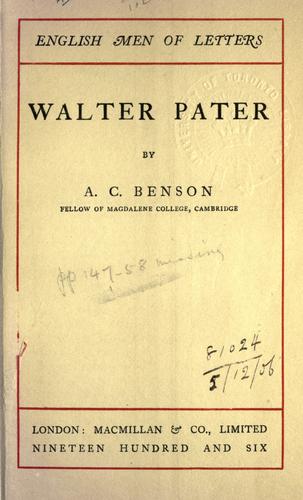
Authors, English -- 19th century -- Biography; Critics -- Great Britain -- Biography; Pater, Walter, 1839-1894
It is clear that he did not aim primarily at simplicity or lucidity.
His style was deliberately adopted and practised, and he was careful
to allow no influence whatever to interfere with it. He told Mr. Gosse
that he had read scarcely a chapter of Stevenson, and not a line of Mr.
Kipling.
“I feel, from what I hear about them,” he said, “that they are
strong; they might lead me out of my path. I want to go on writing
in my own way, good or bad. I should be afraid to read Kipling,
lest he should come between me and my page next time I sat down to
write.”
His view was that slipshod impressionism, rough, sketchy emphasis, was
the literary fault of the time which needed to be sternly resisted.
Writing of a serious kind, he felt, ought to be a strenuous, almost a
learned process. He wrote in one of the reviews he contributed to the
_Guardian_:—
“Well, the good quality of an age, the defect of which lies in
the direction of intellectual anarchy and confusion, may well be
eclecticism.... A busy age will hardly educate its writers in
correctness. Let its writers make time to write English more as a
learned language.”
This thought had its effect upon his writing, even when he was dealing
with the apprehension of the ordinary objects of sense and perception.
Great as was Pater’s appreciation of nature, and fine as was his
perception of the quality and beauty of landscape, it is almost
always through a medium of art that he beheld it. Nature is to him
always a setting, a background, subordinated to the human interest.
The thought that men had laboured, painfully or joyfully, over a
building, or a picture, or a book, invested the result with a certain
sacredness in his eyes. The nearer that outward things approached to
humanity, the more they appealed to Pater. The home, the house, the
room, its furniture and decoration, the garden, the pleasaunce, all
these were nearer to his heart than nature in her wilder and sterner
aspects, because the thought and hand of humanity had passed over
them, writing its care and its dreams legibly on cornice and lintel,
on panel and beam, on chest and press, on alley and bower, on border
and fountain. When, as in “Duke Carl of Rosenmold,” or in “Sebastian
van Storck,” he describes the sunny vine-clad country, or the lonely
clump on the long hill that seems to summon the vagrant foot thither,
or the frozen lake with the fur-clad skaters moving to and fro, it is
always with a sense of how such scenes might have been painted. It was
always nature seen through the eye of the artist rather than in the
mind of the poet. There is little sense of expanse or largeness about
these natural touches; they are rather caught at salient points, in
glimpses and vignettes, grouped and isolated. It may be observed how
rarely he alludes to natural sounds; these visions seem to be seen
in a reflective silence, recorded and represented by the mind that
has stored itself full of minute pictorial impressions. Pater went
Public-domain text, read in full here on John Shaqi.
Reviews
Reviews
No reviews yet
Be the first to share your thoughts on this work.
Elsewhere in the archive
Join the Discussion
Join the discussion
Sign in to leave a comment or review.
Sign InorCreate an account