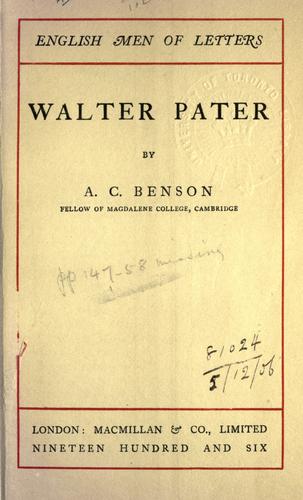
Authors, English -- 19th century -- Biography; Critics -- Great Britain -- Biography; Pater, Walter, 1839-1894
has all been employed; not by elaborately amplifying detail, but by
condensing an abundance of scattered points into a single illuminating
hint, a poignant image, an apt illustration. He was entirely remote
from those easy superficial writers who generalise from insufficient
premises, and bridge the gaps in their knowledge by graceful fabrics of
words. All Pater’s work was strongly focussed; he drew the wandering
and scattered rays, as through a crystal lens, into a burning and
convergent point of light. Not to travel far for instances, the essay
on Leonardo is a perfect example of this. The writing is so delicate,
so apparently fanciful, that it is only through a careful study of
the available tradition that one comes to realise how minute is the
knowledge that furnishes out these gemmed and luminous sentences. It is
true that his knowledge is not pedantically applied, that he concerns
himself little with minute and technical questions of art-criticism;
but I conceive that Pater’s attempt was always to discern the inner
beauty, the essence of the thing; to disentangle the personality, the
humanity of the artist, rather than to classify or analyse the work.
And so it comes about that his art-criticism is essentially a creative
thing, that adds little to the historical aspect of the development
of art, and falls indeed at times into positive error; the training,
the severe observation, the cultivated instinct, is there, but it is
relegated, so to speak, to an ante-room, while the spirit is led to
apprehend something of the mysterious issues of art, initiated into the
secret appreciation of beauty, and drawn to worship in the darkened
innermost shrine. There is always something holy, even priestly, about
Pater’s attitude to art. It insists upon the initial critical training,
the necessity of ordered knowledge; but it leaves this far behind; it
passes beyond the nice apprehension of eye, the cultivated sense of
line and colour, the exact discrimination of style and medium, into a
remote and poetical region. Such secrets cannot be explained or even
analysed; they cannot be communicated to those that are without; they
must be emotionally and mystically apprehended, by the soul rather than
by the mind.
It was this secret vision, this inner enlightening, on which Pater
had set his heart, and which he sought for urgently and diligently.
He loved the symbol, not for itself alone, but for the majesty which
it contained, the hidden light which it guarded. It is in this region
alone that he seems to wear an absorbed and pontifical air, not
with the false sacerdotal desire to enhance personal impressiveness
and private dignity, through the ministry of divine powers and holy
secrets, but with the unconscious emotion of one whose eyes behold
great wonders enacting themselves upon the bodiless air, which the dull
and the contemptuous may not discern.
Public-domain text, read in full here on John Shaqi.
Reviews
Reviews
No reviews yet
Be the first to share your thoughts on this work.
Elsewhere in the archive
Join the Discussion
Join the discussion
Sign in to leave a comment or review.
Sign InorCreate an account