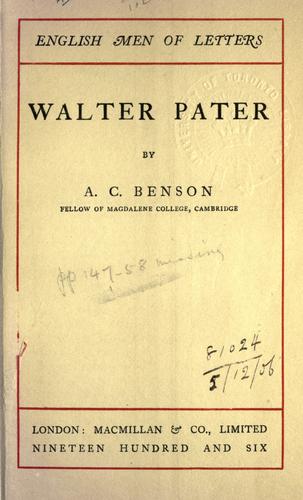
Authors, English -- 19th century -- Biography; Critics -- Great Britain -- Biography; Pater, Walter, 1839-1894
It remains to attempt to indicate Pater’s position in later English
literature, and his philosophy, or rather his point of view, by
summarising what has already, it is to be hoped, been made clear by
analysis.
In literature he practically struck out a new line. The tendency of
the best prose-writers of the century had been, as a rule, to employ
prose in a prosaic manner. Landor had aimed at a Greek austerity of
style. Macaulay had brought to perfection a bright hard-balanced
method of statement, like the blowing of sharp trumpets. This was
indeed the prose that had recommended itself to the taste of the early
Victorians; it was full of a certain sound and splendour; it rolled
along in a kind of impassioned magnificence; but the object of it was
to emphasise superficial points in an oratorical manner, to produce
a glittering panorama rich in detail; it made no appeal to the heart
or the spirit, awaking at best a kind of patriotic optimism, a serene
self-glorification.
Carlyle had written from the precisely opposite point of view; he was
overburdened with passionate metaphysics which he involved in a texture
of rugged Euphuism, intensely mannerised. But he had no catholicity of
grasp, and his picturesqueness had little subtlety or delicacy, because
his intense admiration for certain qualities and types blinded him to
finer shades of character. There was no restraint about his style,
and thus his enthusiasm turned to rant, his statement of preferences
degenerated into a species of frantic bombast.
With these Pater had nothing in common; the writers with whom he
is more nearly connected are Charles Lamb, De Quincey, Newman, and
Ruskin. He was akin to Charles Lamb in the delicacy of touch, the
subtle flavour of language; and still more in virtue of his tender
observation, his love of interior domestic life. He has a certain
nearness to De Quincey in the impassioned autobiographical tendency,
the fondness for retrospect, which Pater considered the characteristic
of the poetical temperament. He is akin to Newman in respect of the
restraint, the economy of effect, the perfect suavity of his work; but
none of these probably exerted any very direct influence upon him.
Ruskin perhaps alone of the later prose-writers had a permanent effect
on the style of Pater. He learnt from Ruskin to realise intensely the
suggestiveness of art, to pursue the subjective effect upon the mind of
the recipient; but though the rich and glowing style of Ruskin enlarged
the vocabulary of Pater, yet we can trace the time when he parted
company with him, and turned aside in the direction of repression
rather than volubility, of severity rather than prodigality.
Public-domain text, read in full here on John Shaqi.
Reviews
Reviews
No reviews yet
Be the first to share your thoughts on this work.
Elsewhere in the archive
Join the Discussion
Join the discussion
Sign in to leave a comment or review.
Sign InorCreate an account