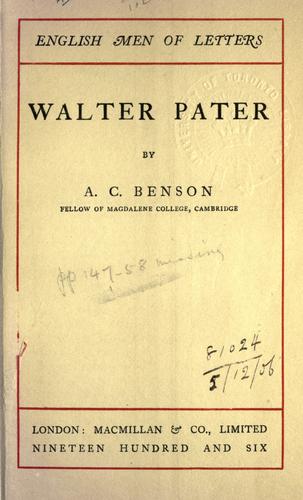
Authors, English -- 19th century -- Biography; Critics -- Great Britain -- Biography; Pater, Walter, 1839-1894
To feel the charm it is necessary to be, to some extent, in sympathy
with the philosophy of Pater. We see in him a naturally sceptical
spirit, desiring to plunge beneath established systems and complacent
explanations; and this, in common with an intense sensibility to every
hint and intimation of beauty, apprehended in a serious and sober
spirit; not the spirit that desires to possess itself of the external
elements, but to penetrate the essential charm. Yet it is not the
patient and untroubled beauty of nature, of simple effects of sun
and shade, of great mountains, of wide plains, but of a remote and
symbolical beauty, seen by glimpses and in corners, of which he was in
search—beauty with which is mixed a certain strangeness and mystery,
that suggests an inner and a deeper principle behind, intermingled with
a sadness, a melancholy, that is itself akin to beauty.
There is always an interfusion of casuistical and metaphysical thought
with Pater’s apprehension of beauty; he seems to be ever desirous to
draw near to the frankness, the unashamed happiness, of the Greek
spirit, but to be for ever held back by a certain fence of scepticism,
a malady of thought.
Yet the beauty of which he takes account is essentially of a religious
kind; it draws the mind to the further issue, the inner spirit. All the
charm of ritual and ceremonial in worship has for Pater an indefinable
and constant attraction. He is for ever recurring to it, because it
seems to him to interpret and express an emotion, a need of the human
spirit, whose concern is to comprehend if it can what is the shadowy
figure, the mysterious will, that moves behind the world of sight and
sense.
We can trace the progress of thought in the case of Pater as clearly
as it is possible to trace the thought of any recent writer; though
reticent and even suavely ironical in talk, he was in his writings
at once self-centred and _intime_. His own emotions, his own
preoccupations, were absorbingly important to him; yet while he shrank
from giving them facile utterance, he was irresistibly impelled to
take the world into his confidence. He had none of the frank egotism
of Wordsworth, none of the complacent belief in the interest of his
revelations of himself; and yet there is no writer that speaks more
persistently and self-consciously of his own point of view. He made
little attempt to pass outside of it, and hardly disguised what he
would fain have concealed. The instinct, indeed, for expression
triumphs at every point over the instinct for reticence.
Public-domain text, read in full here on John Shaqi.
Reviews
Reviews
No reviews yet
Be the first to share your thoughts on this work.
Elsewhere in the archive
Join the Discussion
Join the discussion
Sign in to leave a comment or review.
Sign InorCreate an account