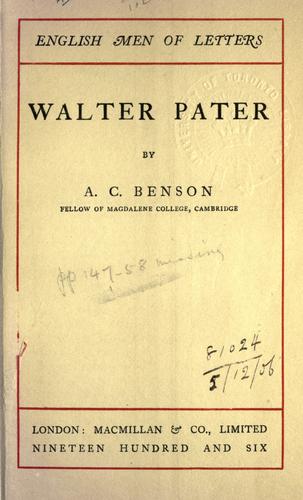
Authors, English -- 19th century -- Biography; Critics -- Great Britain -- Biography; Pater, Walter, 1839-1894
It may be said, then, that Pater really struck out a new line in
English prose, working on the principles enunciated by Flaubert in a
widely different region. The essence of his attempt was to produce
prose that had never before been contemplated in English, full of
colour and melody, serious, exquisite, ornate. He devoted equal pains
both to construction and ornamentation. Whether he is simple and
stately, whether he is involved and intricate, he has the contrast
always in view. His object was that every sentence should be weighted,
charged with music, haunted with echoes; that it should charm and
suggest, rather than convince or state. The danger of the perfection to
which he attained is the danger of over-influence, seductive sweetness;
the value is to suggest the unexplored possibilities of English as a
vehicle for a kind of prose that is wholly and essentially poetical.
The triumph of his art is to be metrical without metre, rhythmical
without monotony. There will, of course, always be those whom this
honeyed, laboured cadence will affect painfully with a sense of
something stifling and over-perfumed; and, indeed, the merits of a work
of art can never be established by explanation or defended by argument;
but to such as can apprehend, feel, enjoy, there is the pleasure of
perfected art, of language that obeys and enriches the thought, of
calculated effect, of realisation, with a supreme felicity of the
intention of the writer.
One does not praise his works as the perfection of style; there is a
limpidity and lucidity of prose style—prose as used by Newman, by
Matthew Arnold, by Ruskin, in chastened moods,—to which no style that
depends upon elaborateness and artifice can attain; but it may fairly
be claimed for Pater that he realised his own conception of perfection.
The style is heavy with ornament, supple with artifice. It is not
so much a picture as an illumination. For sunlight there is stiff
burnished gold; it is full of gorgeous conceits, jewelled phrases; it
has no ease or simplicity; it is all calculated, wrought up, stippled;
but it must be considered from that point of view; it must be appraised
rather than criticised, accepted rather than judged.
Public-domain text, read in full here on John Shaqi.
Reviews
Reviews
No reviews yet
Be the first to share your thoughts on this work.
Elsewhere in the archive
Join the Discussion
Join the discussion
Sign in to leave a comment or review.
Sign InorCreate an account