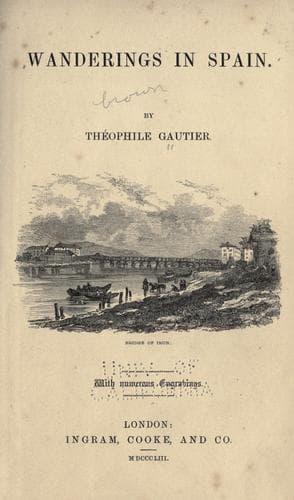
Gautier, Théophile, 1811-1872 -- Travel -- Spain; Spain -- Description and travel; Spain -- Social life and customs -- 19th century
The description of the Museum at Madrid would require a whole
volume. It is rich in the extreme, and contains a very large number
of the works of Titian, Raphael, Paolo Veronese, Rubens, Velasquez,
Ribeira, and Murillo. The pictures are hung in an excellent light,
and the architectural style of the building is tolerably good,
especially in the interior. The Façade looks on the Prado, and is
a specimen of bad taste, but taken altogether the building does
honour to the architect, Villa Nueva, who drew the plans. After
the Museum, the next place to be visited is the Cabinet of Natural
History, containing the mastodon, or _dinotherium giganteum_, a
marvellous specimen of the fossil world, with bones like bars of
iron. It must at least be the behemoth mentioned in the Bible. The
collection also contains a lump of virgin gold weighing sixteen
pounds, a number of Chinese gongs, the sound of which, in spite of
what people say, very much resembles that which is produced if you
kick a copper, and a succession of pictures representing all the
possible varieties which can be produced by crossing white, black,
and copper-coloured races. I must not forget in the academy three
admirable pictures by Murillo,--namely, the Foundation of Santa
Maria Mayora (two pictures), and Saint Elizabeth washing the heads
of persons afflicted with scurvy; two or three admirable Ribeiras;
a Burial, by _El Greco_, some portions of which are worthy of
Titian; a fantastic sketch by the same artist, representing monks
performing different acts of penance, and surpassing the most
mysterious and gloomy creations of Lewis or Anne Radcliffe; and a
charming woman in Spanish costume, lying on a divan, by the good
old Goya, that pre-eminently national painter, who seems to have
come into the world expressly to collect the last vestiges of the
ancient manners and customs of his country, which were about to
disappear for ever.
Francisco Goya y Lucientes, was the last who could be recognised
as a descendant of Velasquez. After him come Aparicio, Lopez, and
others of the same stamp. The decadence of art is complete: the
cyclus is closed! Who shall ever recommence it? Goya is, indeed,
a strange painter--a most singular genius! Never was originality
more decided--never was a Spanish painter more local. One of Goya's
sketches, consisting of four touches of his graver in a cloud of
aquatint, tells you more about the manners of the country than
the longest description. From his adventurous kind of life, his
impetuosity, and his manifold talents, Goya seems to belong to the
best period of the art; and yet he was in some sort a contemporary,
having died at Bordeaux in 1828.
Public-domain text, read in full here on John Shaqi.
Reviews
Reviews
No reviews yet
Be the first to share your thoughts on this work.
Elsewhere in the archive
Join the Discussion
Join the discussion
Sign in to leave a comment or review.
Sign InorCreate an account