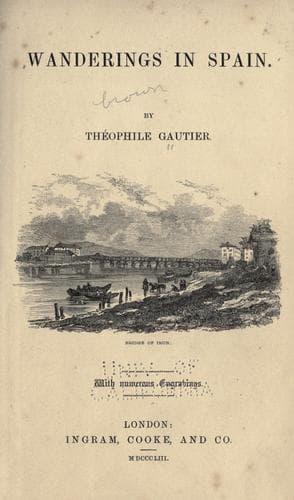
Gautier, Théophile, 1811-1872 -- Travel -- Spain; Spain -- Description and travel; Spain -- Social life and customs -- 19th century
Halfway on the road, at the summit of a pretty steep ascent, is a
poor isolated house, the only one you meet in the course of eight
leagues. Opposite it is a spring, from which a pure and icy stream
trickles down, drop by drop; you drink as many glasses of water
as the spring contains, let your mules rest a short time, and
then set off again on your journey. Soon afterwards you perceive,
standing out from the vapoury background of the mountains, and
rendered visible by a bright gleam of sunshine, that Leviathan of
architecture, the Escurial. At a distance, the effect is very fine;
you would almost fancy it to be an immense Oriental palace, the
stone cupola and the balls which terminate all the elevated points
contributing very much to keep up the illusion. Before reaching
it, you pass through a large wood of olive-trees, ornamented with
crosses, quaintly planted on large blocks of rocks, and producing
the most picturesque effect. On issuing from the wood you enter
the village and find yourself before the colossus, which loses a
great deal from being viewed closely, like all the other colossi
in the world. The first thing that struck me was the great number
of swallows and martins, wheeling about in immense swarms, and
uttering a sharp, strident cry. The poor little birds appeared
terrified by the death-like silence which reigned in this Thebaid,
and were endeavouring to impart a little animation and noise to it.
Every one is aware that the Escurial was built in consequence of a
vow made by Philip II. at the siege of Saint Quentin, when he was
obliged to cannonade a church dedicated to St. Lawrence. Philip
promised the Saint that he would make amends for the church of
which he deprived him, by one that should be more spacious and more
beautiful; and he kept his word more faithfully than the kings of
this earth generally do. The Escurial, which was commenced by Juan
Bautista and completed by Herrera, is assuredly, with the exception
of the Egyptian pyramids, the largest heap of granite that exists
upon the face of the globe; it is called, in Spain, the eighth
wonder of the world, making, as each country has its own eighth
wonder, at least the thirtieth eighth wonder now existing.
Public-domain text, read in full here on John Shaqi.
Reviews
Reviews
No reviews yet
Be the first to share your thoughts on this work.
Elsewhere in the archive
Join the Discussion
Join the discussion
Sign in to leave a comment or review.
Sign InorCreate an account