Gautier, Théophile, 1811-1872 -- Travel -- Spain; Spain -- Description and travel; Spain -- Social life and customs -- 19th century
The Madrid coach sets out from Bayonne. The conductor is a
_mayoral_, with a peaked hat adorned with velvet and silk tufts,
a brown waistcoat embroidered with coloured ornaments, leather
gaiters, and a red sash; these impart a nice little amount of local
colouring. Beyond Bayonne, the country is exceedingly picturesque;
the chain of the Pyrenees becomes more distinct, and beautifully
undulating lines of mountains vary the aspect of the horizon, while
the sea appears frequently to the right of the road. At each turn,
between two mountains, its sombre mild and deep blue suddenly
starts into sight, traversed, here and there, by volutes of foam
whiter than snow, which no painter has, as yet, succeeded in
re-producing. I here beg to apologise to the sea, never having seen
it before but at Ostend, where it is nothing more than the Scheldt,
transformed into a canal, as my dear friend Fritz used so wittily
to express it.
We passed through the church of Urrugne, the dial of which
has the following mournful inscription, in black letters, on
it--"_Vulnerant omnes, ultima necat._" Yes, melancholy dial, you
are right. Each hour wounds us with the sharp point of your hands,
and each turn of your wheel hurries us towards the Unknown!
The houses of Urrugne, and of Saint Jean de Luz, which is not far
distant, possess a sanguinary and barbarous physiognomy, owing to
the strange custom of painting red or blood-colour the doors and
the beams which sustain the compartments of the masonry. Beyond
Saint Jean de Luz is Behobie, the last French village. On the
frontier, the inhabitants practise two kinds of trade to which the
war has given rise--first, that of the balls found in the fields,
and, secondly, that of human smuggling. A Carlist is passed just
like a bale of goods. There is a certain tariff, so much for a
colonel, so much for an inferior officer. As soon as the bargain
is struck, the contrabandist makes his appearance, carries off
his man, passes him over the frontier, and smuggles him to his
destination, as he would a dozen handkerchiefs or a hundred cigars.
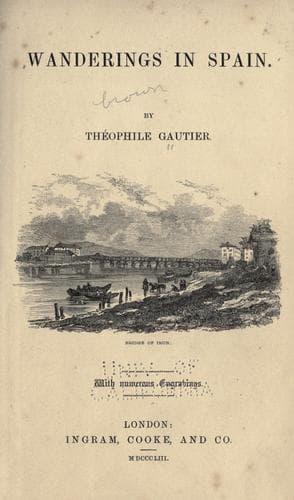
On the other side of the Bidassoa, Irun, the first Spanish village,
is visible: one-half of the bridge belongs to France, the other to
Spain. Close to this bridge is the famous Isle of Pheasants, where
the marriage of Louis XIV. was celebrated by deputy. It would be
difficult to celebrate anything there at present, for it is not
larger than a moderately-sized fried sole.
A few more revolutions of the wheel, and I shall perhaps lose one
of my illusions, and behold the Spain of my dreams, the Spain of
the _Romancero_, of the ballads of Victor Hugo, of the tales of
Merimée, and the stories of Alfred de Musset, fade before me. On
passing the line of demarcation, I remembered what the good and
witty Henri Heine once said to me at Liszt's concert, with his
German accent, full of humour and sarcasm, "How will you manage to
speak of Spain when you have been there?"
Public-domain text, read in full here on John Shaqi.
Reviews
Reviews
No reviews yet
Be the first to share your thoughts on this work.
Join the Discussion
Join the discussion
Sign in to leave a comment or review.
Sign InorCreate an account