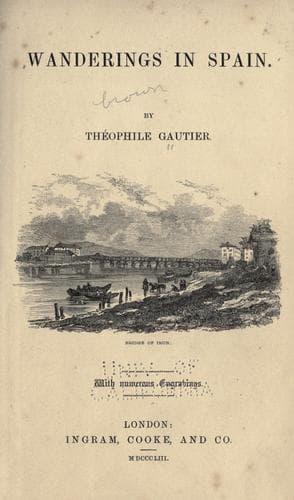
Gautier, Théophile, 1811-1872 -- Travel -- Spain; Spain -- Description and travel; Spain -- Social life and customs -- 19th century
The horses left us at Irun; and ten mules, shaved as far as the
middle of their body--half skin, half hair--like those costumes of
the middle-ages, which look as if they were two-halves of different
suits sown together by chance, were then harnessed to the vehicle.
These animals thus shaved present a strange sight, and appear
most horribly thin; for this denudation enables you to see their
whole anatomy, bones, muscles, and even the smallest veins. With
their peeled tails and their pointed ears, they resemble so many
enormous mice. Besides the ten mules, our band was increased by
a _zagal_ and two _escopeteros_, furnished with their _trabuco_
(blunderbuss). The _zagal_ is a kind of _under-mayoral_, who puts
the drag on whenever there is a dangerous descent, looks after the
harness and the springs, hurries the relays, and plays about the
coach the part of the fly in the fable, only with a great deal
more effect. The costume of the zagal is charming, being most
elegant and light. He wears a peaked hat, ornamented with silk
tufts; a chestnut-coloured or brown jacket, surmounted by a collar
composed of different coloured pieces, generally blue, white, and
red; a large arabesque, which blossoms out upon the middle of his
back, knee-breeches studded with filigree buttons, and for shoes,
_alpargatas_, or sandals tied with thin cord. Add to all this
a red sash and a variegated neck-tie, and you will have a most
characteristic costume. The escopeteros are guards, or _miquelets_,
whose office it is to escort the coach and frighten the _rateros_,
as the petty robbers are termed, who would not resist the
temptation of plundering a solitary traveller, but whom the
edifying sight of the _trabuco_ is sufficient to awe, and who pass
on their way with the sacramental salutation of--_Vaya Usted con
Dios_: "Pursue your road with God." The dress of the escopeteros
is nearly the same as that of the zagal, but less coquettish and
ornamented. They take up their position on the seat at the back of
the coach, and thus command the country around. In this description
of our caravan, I have forgotten to mention a little postilion,
mounted on horseback at the head of the convoy, who leads off the
whole line.
Before leaving, we had to get our passports, already pretty well
covered with signatures, _viséd_. While this important operation
was in course of performance, we had leisure to cast a glance at
the population of Irun, which offers nothing very particular,
unless it be that the women wear their hair, which is remarkably
long, united in one plait hanging down to the middle of their back;
shoes are a rarity, and stockings a still greater one.
Public-domain text, read in full here on John Shaqi.
Reviews
Reviews
No reviews yet
Be the first to share your thoughts on this work.
Join the Discussion
Join the discussion
Sign in to leave a comment or review.
Sign InorCreate an account