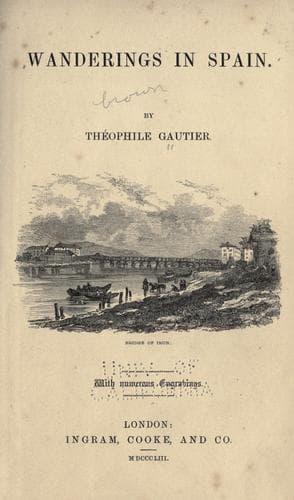
Gautier, Théophile, 1811-1872 -- Travel -- Spain; Spain -- Description and travel; Spain -- Social life and customs -- 19th century
The people you meet dressed in modern costumes, wearing
broad-brimmed hats and long frock-coats, involuntarily produce on
you a disagreeable effect, and appear more ridiculous than they
really are; for, after all, they cannot be expected to walk about,
for the sake of the local colouring, in the Moorish _albornoz_ of
the time of Boabdil, or in the iron armour of the time of Ferdinand
and Isabella the Catholic. Like nearly all the citizens of every
town in Spain, they think it necessary for their honour to show
that they are not at all picturesque, and to prove, by the means
of trousers and straps, their progress in civilization. Such is
the prevailing idea which occupies their minds; they are afraid
of appearing barbarous or backward; and when you admire the wild
beauty of their country, they humbly beg you to excuse them for
having no railways yet, and for being without steam-engines in
their manufactories. One of these honest citizens, to whom I was
extolling the charms of Granada, replied, "It is the best lighted
city in Andalusia. Just look at the number of its lamps; but what a
pity it is that they are not gas ones!"
Granada is gay, smiling, animated, although much fallen from its
former splendour. The inhabitants are everywhere, and well merit
the name of a numerous population; the carriages are handsomer and
more plentiful than at Madrid. The sprightliness of the Andalusians
fills the streets with bustle and life--things unknown to the grave
Castilian, who, as he goes along, makes no more noise than his
shadow: this remark particularly applies to the Carrera del Darro,
the Zacatin, the Plaza Nueva, the Calle de los Gomeles, which leads
to the Alhambra, to the square before the theatre, to the entrances
to the parade, and to all the leading thoroughfares. The rest of
the city is intersected in all directions by inextricable lanes of
three or four feet in width, through which no vehicles can pass,
and which remind you of the Moorish streets of Algiers. The only
sound heard there is the noise made by the hoof of a donkey or a
mule, which strikes a light every now and then on the glittering
flints which pave the road, or the monotonous tinkling of a guitar
which some one is playing at the bottom of a yard.
Public-domain text, read in full here on John Shaqi.
Reviews
Reviews
No reviews yet
Be the first to share your thoughts on this work.
Elsewhere in the archive
Join the Discussion
Join the discussion
Sign in to leave a comment or review.
Sign InorCreate an account