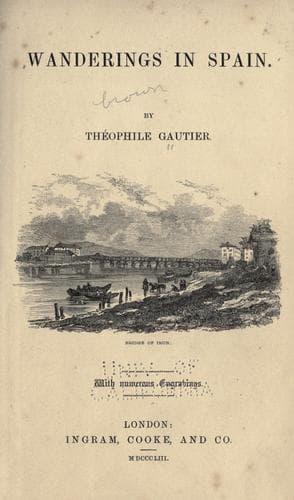
Gautier, Théophile, 1811-1872 -- Travel -- Spain; Spain -- Description and travel; Spain -- Social life and customs -- 19th century
At present, hardly anything else is played in Spanish theatres but
translations of French dramas and vaudevilles. At Jaen, in the
very heart of Andalusia, they give "Le Sonneur de Saint Paul;" at
Cadiz, which is but two steps from Africa, "Le Gamin de Paris."
The "Saynetes," which were formerly so gay and so original, and
possessing such a strong local tinge, are at present nothing save
imitations of the repertory of the Théâtre des Variétés. Not to
speak of Don Martinez de la Rosa, and Don Antonio Gil y Zarate, who
already belong to a less recent period, the Peninsula can still
boast of several young and talented authors of great promise; but
public attention in Spain, as in France, is diverted from the stage
by the gravity of political events. Hartzembusch, the author of
the "Lovers of Ternel;" Castro y Orozco, to whose pen we owe "Fray
Luis de Leon, or the Age and the World;" Zorilla, who brought out
successfully the drama of "El Rey y el Zapatero;" Breton de los
Herreros, the Duke de Rivas, Larra, who committed suicide for love;
Espronceda, whose death has just been announced in the papers, and
whose writings were characterized by a wild and passionate energy,
sometimes worthy of his model, Byron, are--alas! in speaking of the
last two we must say, were, men of great literary merit, ingenious,
elegant, and easy poets, who might take their places by the side
of the old masters, did they not want what we all want,--namely, a
sure and certain point to start from, a stock of ideas common both
to them and the public. The point of honour and the heroism of the
old pieces are either no longer understood or appear ridiculous,
and the belief of modern times is not sufficiently definite to
enable poets to describe it in their verse.
We must not, therefore, be too severe in judging the crowd, who
rush to the bull-ring and seek for emotion where it is to be
found; after all, it is not the people's fault that the stage
is not more attractive; all the worse for us poets, if we allow
ourselves to be beaten by the gladiators. In conclusion, it is more
healthy both for the mind and the body to see a brave man kill a
savage beast beneath the canopy of heaven, than to listen to an
actor without talent singing some obscene vaudeville, or spouting a
number of sophisticated lines before a row of smoky footlights.
CHAPTER XII.
FROM MALAGA TO SEVILLE.
The Four-wheeled Galera--Caratraca--The "Mayoral"--Ecija--The
"Calle de los Caballeros"--La Carlotta--Cordova--The Archangel
Raphael--The Mosque--Caliph Abderama--The Guadalquiver--Road to
Seville.
Public-domain text, read in full here on John Shaqi.
Reviews
Reviews
No reviews yet
Be the first to share your thoughts on this work.
Elsewhere in the archive
Join the Discussion
Join the discussion
Sign in to leave a comment or review.
Sign InorCreate an account