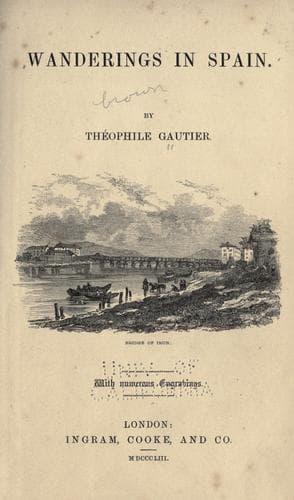
Gautier, Théophile, 1811-1872 -- Travel -- Spain; Spain -- Description and travel; Spain -- Social life and customs -- 19th century
As yet we were only acquainted with the _galera_ on two wheels; we
now had the pleasure of making a trial of one on four. An amiable
vehicle of this description happened to be about starting for
Cordova; it was already occupied with a Spanish family, and we
helped to fill it still more. Just fancy rather a low wagon, with
its sides formed of a number of wooden spokes at a considerable
distance from each other, and having no bottom save a strip of
spartum on which the trunks and packages are heaped, without much
attention to the irregularities of surface which they may present.
Above the luggage are thrown two or three mattresses, or, to speak
more correctly, two or three linen sacks, in which a few tufts of
wool but very slightly carded, float about, and on these mattresses
the unfortunate travellers are stretched transversely, in a
position very similar (excuse the triviality of the comparison)
to that of calves that are being carried to market. The only
difference is, that the travellers do not have their feet tied,
but their situation is not much more comfortable for all that. The
top consists of a coarse cloth, stretched on wooden hoops, and the
whole machine is driven by a _mayoral_ and dragged by four mules.
Our fellow-travellers consisted of the family of an engineer,
who was rather a well educated man, and spoke very good French.
They were accompanied by a tall, villanous, fantastic-looking
individual, who had formerly been a brigand in Jose Maria's gang,
and who was now a superintendent of mines. This gentleman followed
the _galera_ on horseback, with a knife stuck in his girdle and a
carbine slung at his saddle-bow. The engineer appeared to entertain
a high opinion of him, and spoke in very favourable terms of
his probity, of which he was perfectly convinced in spite of
the superintendent's old trade. It is true that in speaking of
Jose Maria himself, he told me several times that he was a brave
and worthy man. This opinion, which would strike us as slightly
paradoxical in the case of a highway robber, is that of the most
honourable persons in Andalusia. On this point, Spain is still
Arabian, and brigands very frequently are looked upon as heroes.
This is less strange than it may at first appear, especially in
southern countries, where men's minds are so easily acted on. Is it
not certain that the contempt of death, audacity, coolness, bold
and prompt determination, address, and bodily strength, and all
the kind of grandeur which belongs to a man who revolts against
society, as well as the qualities which exercise so great an
influence over minds as yet but little civilized, are exactly those
which constitute great characters, and is the people so very wrong
in admiring them in these energetic individuals, even although they
employ them in a reprehensible manner?
Public-domain text, read in full here on John Shaqi.
Reviews
Reviews
No reviews yet
Be the first to share your thoughts on this work.
Elsewhere in the archive
Join the Discussion
Join the discussion
Sign in to leave a comment or review.
Sign InorCreate an account