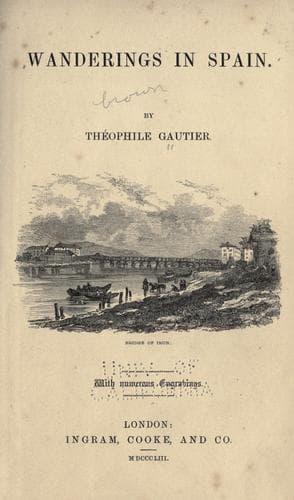
Gautier, Théophile, 1811-1872 -- Travel -- Spain; Spain -- Description and travel; Spain -- Social life and customs -- 19th century
The ground became more and more sandy, and the wheels of the
calessin sank up to their naves in the shifting soil. We now
understood why our driver had so strongly objected to our specific
gravity. To ease the horse a little, we got down, and, about
midnight, after having followed a road which wound round a steep
rock in a zigzag direction, we reached Cormana, where we were to
pass the night. Some limekilns cast their long, reddish reflection
over the line of rocks, producing most powerful and admirably
picturesque Rembrandt-like effects.
The room into which we were shown was ornamented with some wretched
lithographed plates representing various episodes of the revolution
of July, such as the taking of the Hôtel de Ville, and so on.
This circumstance pleased and almost moved us; it was like seeing
a piece of France framed and hung up against the wall. Cormana,
which we had scarcely time to look at, as we once more got into
our calessin, is a little town as white as cream; the campanilas
and towers of an old convent of Carmelite nuns give it a very
picturesque appearance, and that is all we can say about it.
Beyond Cormana, luxuriant plants, cactuses, and aloe-trees, which
had for some time deserted us, now appeared again more bristling
and ferocious than ever. The landscape was less bare and arid, and
more varied; the heat, too, had lost something of its intensity.
We soon afterwards reached Alcala de los Panaderos, celebrated
for the excellence of its bread, as its name signifies, and for
its _novillos_ (young bulls) fights, to which the _aficionados_
of Seville resort when the circus there is closed. Alcala de los
Panaderos is situated very pleasantly at the bottom of a small
valley, irrigated by a river; it is sheltered by a hill, on which
the ruins of an old Moorish palace are still standing. We were
approaching Seville; in fact, it was not long ere the Giralda
displayed on the horizon its open lantern and then its square
tower: a few hours afterwards we were passing through the Puerta
de Cormana, whose arch enclosed a background of dusty light, in
which galeras, asses, mules, and carts drawn by oxen, some coming
to the town and others leaving it, crossed each other in a flood of
golden vapour. To the left of the road arose the stone arcades of
a superb aqueduct, of a truly Roman appearance: on the other side
were rows of houses built nearer and nearer to each other: we were
at Seville.
CHAPTER XIII.
SEVILLE.
Seville--The Cristina--The Torre del Oro--Italica--The
Cathedral--The Giralda--El Polbo Sevillano--The Caridad and Don
Juan de Marana.
There is a Spanish proverb, very frequently quoted, on Seville:
"Quien no ha visto a Sevilla
No ha visto a maravilla."
We confess, in all humility, that this proverb would strike us
as more correct if applied to Toledo or Granada rather than to
Seville, where we saw nothing particularly marvellous, unless it
was the Cathedral.
Public-domain text, read in full here on John Shaqi.
Reviews
Reviews
No reviews yet
Be the first to share your thoughts on this work.
Elsewhere in the archive
Join the Discussion
Join the discussion
Sign in to leave a comment or review.
Sign InorCreate an account