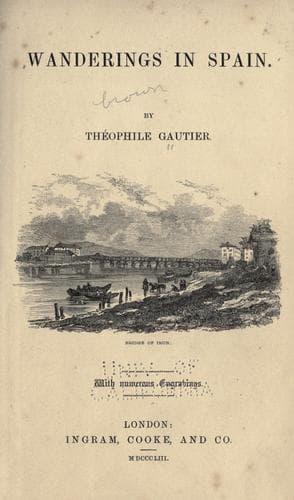
Gautier, Théophile, 1811-1872 -- Travel -- Spain; Spain -- Description and travel; Spain -- Social life and customs -- 19th century
Seville is situated on the banks of the Guadalquiver, in a
large plain, whence it derives its name of Hispalis, which, in
Carthagenian, means a flat piece of ground, if we may believe Arias
Montano and Samuel Bockhart. It is a vast, straggling town, of very
recent date, gay, smiling, and animated, and must really appear a
charming place to Spaniards. It would be impossible to find a more
striking contrast to Cordova. The town of Cordova is dead; it is
an ossuary, a catacomb in the open air, on which Neglect is slowly
sprinkling its white dust; the few inhabitants whom you meet at
the corners of its narrow streets look like apparitions which have
mistaken the hour. Seville, on the contrary, is full of all the
petulance and busy hum of life; the sound of gaiety floats over
her at every instant of the day; she hardly allows herself time to
take her siesta. She cares little for yesterday, and still less for
to-morrow; she exists altogether for the present. Memory and Hope
are the consolation of those who are unhappy, and Sevilla is happy.
She enjoys herself, while her sister, Cordova, wrapt in silence and
solitude, appears to be dreaming mournfully of Abderama; of the
great captain and all his departed glories, brilliant meteors in
the nights of the Past, while all she now possesses are ashes.
To the great disappointment of travellers and antiquaries,
whitewash reigns supreme at Seville; the houses have a new coat
of it three or four times a year; this gives them a look of
cleanness and neatness, but effectually prevents any investigation
of the remains of the Arabic and Gothic sculptures which formerly
adorned the place. Nothing can be less varied than this network
of streets, where the eye sees but two tints--the indigo of the
sky and the chalky white of the walls on which the azure shadows
of the neighbouring buildings are thrown; for in warm countries
the shadows are blue instead of being grey, so that the objects
appear to be lighted up on one side by the moon, and on the other
by the sun; the absence, however, of all sombre tints produces a
general appearance of life and gaiety. Doorways closed with iron
gates allow you to look through and see the _patios_ ornamented
with columns, mosaic pavement, fountains, flower-pots, shrubs,
and pictures. As regards the external architecture, it offers no
particularly remarkable feature; the houses are rarely more than
two or three stories high, and you hardly meet with a dozen façades
that are interesting in an artistic point of view. The streets are
paved, like those of all Spanish towns, with small pebbles, but,
on each side, there is a kind of pavement consisting of tolerably
large flat stones on which the crowd walks in single file. If a
man and woman meet, the man always makes way for the woman with
that exquisite politeness which is natural to Spaniards, even of
the very lowest classes. The women of Seville quite deserve the
reputation for beauty which they enjoy; they are almost all alike,
Public-domain text, read in full here on John Shaqi.
Reviews
Reviews
No reviews yet
Be the first to share your thoughts on this work.
Elsewhere in the archive
Join the Discussion
Join the discussion
Sign in to leave a comment or review.
Sign InorCreate an account