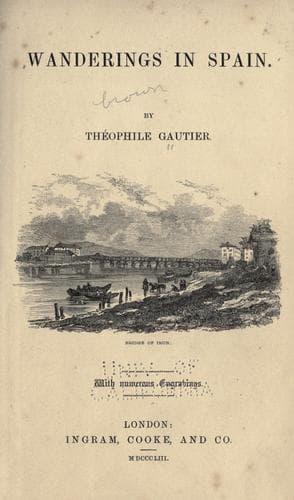
Gautier, Théophile, 1811-1872 -- Travel -- Spain; Spain -- Description and travel; Spain -- Social life and customs -- 19th century
The Cristina is a superb promenade, on the banks of the
Guadalquiver, with a _saloon_ paved with large stone flags, and
surrounded by an immense white marble sofa with an iron back. It
is shaded by Eastern plane-trees, and has a labyrinth, a Chinese
pavilion, and plantations of all kinds of northern trees, such as
ashes, cypresses, poplars, and willows, of which the Andalusians
are as proud as the Parisians would be of aloe-trees and palms.
At the approaches to the Cristina, pieces of rope, dipped in
brimstone, and rolled round posts, are always kept burning in order
that the smokers may light their cigars, and not be bored by boys
with coals, pursuing them with the cry of _Fuego_; an annoyance
which renders the Prado of Madrid insupportable.
But delightful as this promenade was, I preferred the banks of the
river itself, where the prospect was always animated and constantly
changing. In the middle of the stream, where the water was deepest,
were anchored merchant schooners and brigs, their tapering masts
and airy rigging standing out in clear black lines from the light
background of the sky. In all directions, smaller craft were seen
crossing and recrossing each other. Sometimes a boat would bear
down the stream a number of young men and women, playing the guitar
and singing _coplas_, whose rhymes were dispersed by the wanton
wind, while the promenaders applauded from the banks. The view was
beautifully terminated, on this side, by the _Torre del Oro_, a
kind of octagon tower with three receding stories, and Moorish
battlements: it laves its base in the waves of the Guadalquiver,
near the landing-place, and shoots up into the blue air from
the midst of a forest of masts and cordage. This tower, which
the learned pretend to have been constructed by the Romans, was
formerly connected with the Alcazar by means of walls, which have
been pulled down to make room for the Cristina, and, in the time
of the Moors, supported one end of the iron chain which defended
the passage of the river, while the other end was fastened to
stone piers on the opposite side. It is said to derive its name of
_Torre del Oro_ from the fact of the gold which was brought in the
galleons from America having been kept there.
[Illustration: THE TORRE DEL ORO.]
We used to go and walk here every evening, looking at the sun as it
set behind the Triana suburbs, which are on the other side of the
stream. A most noble-looking palm raised in the air its leafy disk,
as if to salute the sinking luminary. I was always exceedingly
fond of palms, and I can never see one without feeling transported
into a patriarchal and poetical world, in the midst of the fairy
scenes of the East, and the magnificent pictures of the Bible.
Public-domain text, read in full here on John Shaqi.
Reviews
Reviews
No reviews yet
Be the first to share your thoughts on this work.
Elsewhere in the archive
Join the Discussion
Join the discussion
Sign in to leave a comment or review.
Sign InorCreate an account