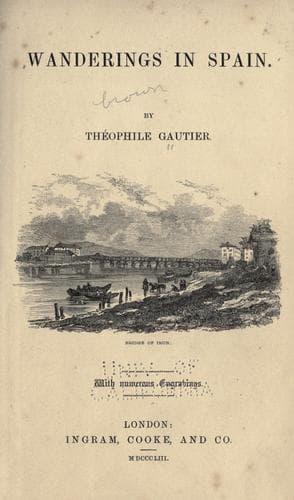
Gautier, Théophile, 1811-1872 -- Travel -- Spain; Spain -- Description and travel; Spain -- Social life and customs -- 19th century
As may easily be imagined, we rose with the dawn. The fact of
entering, for the first time, a town at night, is one of the things
which most excites the curiosity of a traveller: he makes the most
desperate endeavours to distinguish the general appearance of the
streets, the form of the public buildings, and the physiognomies
of the few people he meets in the dark, so that he has at least
the pleasure of being surprised, when, the next morning, the town
suddenly appears all at once before him, like the scene in a
theatre when the curtain is raised.
Neither the palette of the painter nor the pen of the writer
possesses colours sufficiently bright, nor tints sufficiently
luminous, to convey any idea of the brilliant effect that Cadiz
produced upon us that glorious morning. Two unique tints struck our
view; blue and white--the blue as vivid as turquoises, sapphires,
or cobalt, in fact the very deepest azure that can be imagined,
and the white as pure as silver, snow, milk, marble, or the finest
crystallized sugar! The blue was the sky repeated by the sea; the
white was the town. It is impossible to conceive anything more
radiant and more dazzling--to imagine light more diffused, and, at
the same time, more intense. In sober truth, what we term the sun
in France is, in comparison, nothing but a pale night-lamp at the
last gasp, by the bedside of a sick man.
The houses at Cadiz are much loftier than those in the other towns
of Spain. This is explained by the conformation of the ground,
which is a small narrow island connected with the continent by a
mere strip of land, as well as from the general desire to have a
view of the sea. Each house stands on tiptoe with eager curiosity,
in order to look over its neighbour's shoulder, and raise itself
above the thick girdle of ramparts. This, however, is not always
found sufficient, and at the angle of nearly all the terraces,
there is a turret, a kind of belvedere, sometimes surmounted by a
little cupola. These aërial miradores enrich the outline of the
town with innumerable dentations, and produce a most picturesque
effect. Every building is whitewashed, and the brilliancy of
the façades is increased still more by long lines of vermilion
which separate the houses and mark out the different stories: the
balconies, which project very far, are enclosed in large glass
cages, furnished with red curtains and filled with flowers. Some
of the cross streets terminate on the open space, and seem to end
in the sky. These stray bits of azure charm you by their being so
totally unexpected. Apart from this gay, animated and dazzling
appearance, Cadiz can boast of nothing particular in the way of
architecture. Although its cathedral, which is a vast building of
the sixteenth century, is wanting neither nobleness nor beauty,
it presents nothing to astonish, after the prodigies of Burgos,
Toledo, Cordova, and Seville; it is something in the same style
as the cathedrals of Jaen, Granada, and Malaga; it is a specimen
Public-domain text, read in full here on John Shaqi.
Reviews
Reviews
No reviews yet
Be the first to share your thoughts on this work.
Elsewhere in the archive
Join the Discussion
Join the discussion
Sign in to leave a comment or review.
Sign InorCreate an account