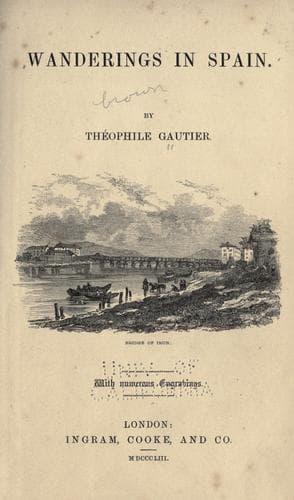
Gautier, Théophile, 1811-1872 -- Travel -- Spain; Spain -- Description and travel; Spain -- Social life and customs -- 19th century
and Toulon of the Peninsula; it is there that the Spaniards send
their most hardened galley-slaves. We could distinctly make out its
rocky precipices, and its crest enveloped in clouds, despite the
serenity of the surrounding sky.
Like Cadiz, Gibraltar, situated on a peninsula at the entrance of
a gulf, is only connected with the continent by a narrow strip of
land called the _Neutral Ground_, where the custom-house lines
are established. The first Spanish possession on this side is San
Roque. Algeciras, whose white houses glisten in the universal
azure, like the silvery stomach of a fish floating on the surface
of the water, is exactly opposite Gibraltar; in the midst of this
splendid blue, Algeciras was having its little revolution. We heard
indistinctly the popping report of fire-arms, like the noise made
by grains of salt when thrown into the fire. The _ayuntamiento_
even took refuge on board the steamer, and began smoking cigars in
the most tranquil manner in the world.
The officers of health not having found that we brought any
infectious disease with us, we were surrounded by small boats,
and, in another quarter-of-an-hour, we were on shore. The effect
produced by the appearance of the town is the strangest it is
possible to conceive. By taking one step, you have your five
hundred leagues, which is rather more than even Tom Thumb did in
his famous boots. Just now you were in Andalusia, at the next
moment you are in England. From the Moorish towns of Granada and
Murcia, you suddenly alight at Ramsgate: you see brick-houses
with their areas, their low doors, and their English windows,
exactly like those at Twickenham or Richmond. If you go a little
further, you will perceive cottages with their painted railings
and gates. The public walks are planted with ash and birch trees,
with elms and the green vegetation of the north, so different
from those small plates of varnished metal which pass for foliage
in southern climates. Englishmen have so strong an individuality
that they are everywhere the same, and I really cannot understand
why they travel, for they carry all their customs with them, and
bear their houses on their backs exactly like snails. Wherever an
Englishman may be, he lives precisely as he would do in London; he
must have his tea, his rumpsteaks, his rhubarb pies, his porter,
and his sherry, if he is well; and his calomel, if he is ill. By
means of the innumerable packages he lugs about with him, the
Englishman always enjoys his _home_ and his _comfort_, which
are necessary to his existence. How many objects do our insular
neighbours require in order to live--how much trouble do they give
themselves to feel at their ease?--and how much do I prefer to all
this complicated array, Spanish abstemiousness and privation! It
was a very long time since I had seen a female with one of those
horrible coal-scuttle affairs, one of those odious pasteboard
cases covered with a slip of stuff, and called bonnets, in which
Public-domain text, read in full here on John Shaqi.
Reviews
Reviews
No reviews yet
Be the first to share your thoughts on this work.
Elsewhere in the archive
Join the Discussion
Join the discussion
Sign in to leave a comment or review.
Sign InorCreate an account