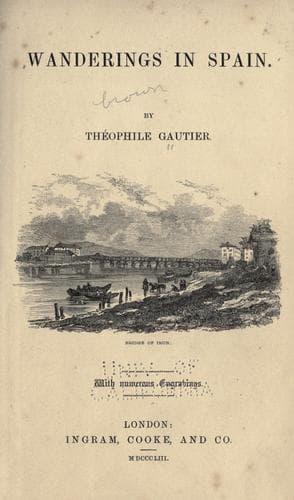
Gautier, Théophile, 1811-1872 -- Travel -- Spain; Spain -- Description and travel; Spain -- Social life and customs -- 19th century
A detachment of the cavalry of the National Guard, exceedingly
well mounted and equipped, now rode round the arena, preceded
by two alguazils in their costume, which consists of a large
broad-brimmed hat and feather, in the style of Henri IV., black
doublet and cloak, and large boots. Their duty was to drive away
some few obstinate _aficionados_ and certain dogs that were still
loitering in the ring. As soon as this was effected, the alguazils
went and fetched the _toreros_, under which term are included
the _picadores_, _chulos_, _banderilleros_, and the _espada_,
who is the principal performer in the drama. These personages
made their entry to a flourish of trumpets. The _picadores_ were
mounted on horses with their eyes hooded, as the sight of the bull
might frighten them and cause them to shy, thereby endangering
the safety of their riders. The costume of the _picadores_ is
highly picturesque. It is composed of a short vest, which does not
button, of orange, carnation, green or blue velvet, loaded with
gold or silver embroidery and spangles, fringe, filigree buttons
and ornaments of all kinds, especially on the shoulders, where the
stuff is completely hidden beneath a glittering and phosphorescent
mass of twisted arabesque-work. Under this is a waistcoat in the
same style, a frilled shirt, a variegated neck-handkerchief tied
carelessly round the neck, and a silk sash round the waist. Their
pantaloons are of fawn-coloured buff, stuffed inside and lined
with thin metal plates, like the boots of the French postilions,
in order to protect the wearers' legs from being gored by the
bull. A grey, low-crowned hat (_sombrero_), with an immense brim,
and ornamented with an enormous tuft of favours, and a large mesh
or net of black ribbons, which is called, I believe, a _moño_,
and holds the hair gathered up in a pigtail at the back of the
head, complete the dress. The _picador_ is armed with a lance, at
the end of which is an iron spike two or three inches long. This
spike cannot wound the bull dangerously, but is enough to irritate
or keep him at bay. A piece of leather fitted to the _picador's_
hand, prevents the lance from slipping. The saddle rises very high,
both behind and before, and resembles those strengthened with iron
plates, in which the knights of the Middle Ages used to be buried
in the tournaments. The stirrups are made of wood, and form a kind
of shoe, like the Turkish stirrups. A long, iron spur, as sharp as
a dagger, is fixed in the rider's heel. An ordinary spur would not
be sufficient to govern the horses, who are often half dead.
Public-domain text, read in full here on John Shaqi.
Reviews
Reviews
No reviews yet
Be the first to share your thoughts on this work.
Elsewhere in the archive
Join the Discussion
Join the discussion
Sign in to leave a comment or review.
Sign InorCreate an account