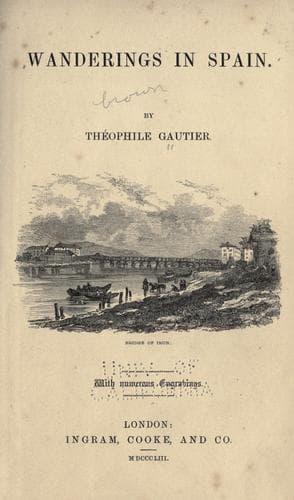
Gautier, Théophile, 1811-1872 -- Travel -- Spain; Spain -- Description and travel; Spain -- Social life and customs -- 19th century
Let us now go about the town as chance may lead us, for chance is
the best guide, especially as Madrid is not rich in architectural
beauties, and as one street is as remarkable as another. The
first thing that you perceive on the angle of a house or street
directly you raise your nose in the air, is a small porcelain
plate with the following inscription--_Manzana. vicitac. gener._
These plates formerly served to number entire blocks or heaps of
houses. At present each house is numbered separately, as in Paris.
The quantity of plates that decorate the fronts of the houses and
inform you that they are insured against fire, would excite your
astonishment, especially in a country where there are no fireplaces
and no fires. Everything is insured, including even the public
monuments and churches. The civil war, it is said, is the cause of
this great alacrity in insuring. As no one is certain of not being
more or less fried alive by some Balmaseda or other, he endeavours
to save at least his house.
The houses of Madrid are built of lath and plaster, and bricks,
save the jambs, the belting courses, and the straps, which are
sometimes of grey or blue granite. The whole is rough-cast,
and painted fantastically enough, sea-green, bluish ash-colour,
fawn-colour, canary, and other hues more or less Anacreontic. The
windows are surrounded by imitations of architectural ornaments
of every description, with an infinite profusion of volutes,
scroll-work, little loves and flower-pots. They have likewise large
Venetian blinds with broad blue and white stripes, or spartum
matting, which is sprinkled with water in order that it may render
the wind cool and humid as it passes through. The modern houses
are merely whitewashed, or coloured cream-colour like those in
Paris. The balconies and _miradores_ jutting out from the walls,
somewhat relieve the monotony of so many straight lines with their
regular well-defined shadow, and diversify the naturally flat
aspect of all these buildings, in which the portions that should
be raised in relief are merely painted, as they would be on a
scene in a theatre. Fancy all this lighted up with a blazing sun;
at certain distances along these streets bathed in light, place
a few long-veiled señoras spreading their fans out like parasols
and holding them against their cheeks; a few bronzed and wrinkled
beggars, clothed in scraps of cloth and rags as rotten as tinder;
some few Valencians, half-naked and looking like Bedouins; imagine
that you behold rising up between the housetops the small dwarf
cupolas, and little bulging bell-turrets, terminated by leaden
balls, and belonging to some church or convent, and the result will
be rather a strange kind of scene, which will at least prove that
you are no longer in the Rue Lafitte, and that you have decidedly
left the Parisian asphalte for the time being, even if your feet,
which are cut about by the pointed flint-stones of the pavement,
had not already convinced you of the fact.
Public-domain text, read in full here on John Shaqi.
Reviews
Reviews
No reviews yet
Be the first to share your thoughts on this work.
Elsewhere in the archive
Join the Discussion
Join the discussion
Sign in to leave a comment or review.
Sign InorCreate an account