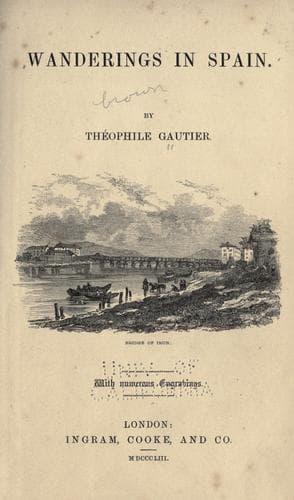
Gautier, Théophile, 1811-1872 -- Travel -- Spain; Spain -- Description and travel; Spain -- Social life and customs -- 19th century
The houses are vast and convenient inside; the rooms are lofty, and
the architects have evidently not been cramped for space. In Paris
a whole house would be built in the well of certain staircases I
have seen here. You traverse a long succession of rooms before
reaching that part of the house which is really inhabited, for
the furniture of all these said rooms consists only of a little
whitewash, or a dull yellow or blue tint, relieved by a fillet
of colour and sham panelling. Smoky, black-looking pictures,
representing some martyr or other in the act of being beheaded
or ripped open, favourite subjects with Spanish painters, are
suspended against the walls, most of them having no frames, and
hanging in folds on the wood-work. Board flooring is a thing that
is not known in Spain--at least, I never saw any there. Every
room is paved with bricks; but as these bricks are, during the
winter, covered with matting made of grass, and during the summer
with matting made of rushes, they are much less disagreeable than
they otherwise would be. This matting is made with great taste;
it could not be better even if manufactured by savages of the
Philippine or Sandwich Islands. There are three things which, in
my eyes, determine with the precision of thermometers the state of
a people's civilization: these are--its pottery-ware, the degree
of skill it possesses in plaiting osiers or straw, and its manner
of caparisoning its beasts of burden. If the pottery is handsome,
pure in form, as correct as the antique, and with the natural
colour of the white or red clay; if the baskets and the matting
are fine, wonderfully entwined, and enhanced by arabesques of the
most admirably-selected colours; and if the harness is embroidered,
stitched, and decorated with bells, tufts of wool, and elegant
designs, you may be sure that the people is in a primitive state,
still very near that of nature: civilized nations can make neither
a pot, a mat, nor a set of harness. At the moment I am writing
these lines, there is hanging before me, attached to a column by a
small string, the _jarra_, in which the water I drink is cooling.
This _jarra_ is an earthen pot, worth twelve _cuartos_,--that is
to say, about six or seven French sous: its outline is charming,
and, with the exception of the productions of Etruscan art, I
never saw anything more pure. It spreads out at the top, forming
a sort of trefoil with four leaves, each of which has a slight
indenture down the middle, so that the water can be poured out
in whatever direction the vessel happens to be taken up. The
handles, which are ornamented with a small hollow moulding, are
most elegantly joined on to the neck and sides; the swell of the
latter is delicious. Instead of these charming vases, the wealthy
people prefer abominable big-bellied, podgy, ill-shapen English
pots, covered with a thick coating of varnish, and resembling large
jack-boots polished white. But while talking of boots and pottery
Public-domain text, read in full here on John Shaqi.
Reviews
Reviews
No reviews yet
Be the first to share your thoughts on this work.
Elsewhere in the archive
Join the Discussion
Join the discussion
Sign in to leave a comment or review.
Sign InorCreate an account