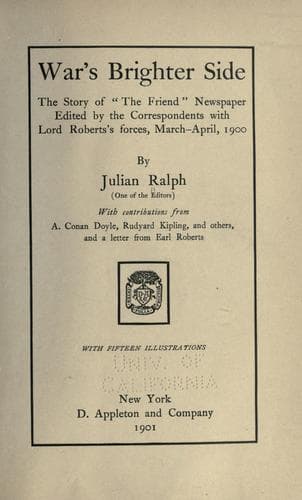
War's Brighter Side: The Story of The Friend Newspaper Edited by the Correspondents with Lord Roberts's Forces, March-April, 1900Ralph, Julian
History
War's Brighter Side: The Story of The Friend Newspaper Edited by the Correspondents with Lord Roberts's Forces, March-April, 1900
Ralph, Julian
Friend (Bloemfontein, South Africa); South African War, 1899-1902 -- Periodicals
At the same time I do not wish, for a moment, to lay it down as one
of the rules of modern warfare that guns can be worked with impunity
within 1,500 or even 2,000 yards of the enemy's rifle fire, for the
danger of being put out is so apparent that it needs no demonstration.
But artillery must have a good "position." Batteries cannot be hidden
behind boulders as infantry soldiers can. Gunners must have an open
field and more or less a commanding point from which to lay their
guns. This necessity--a necessity to which no other arms are so
completely subjected--has entailed, during the course of the present
war, the risk of whole batteries being under rifle fire. Before the
introduction of the long-range rifle, there were but few instances
where guns, in order to take up proper positions, were forced to come
under effective rifle fire. Now, however, we have to face this risky
possibility. And in this respect, and this respect only, can the use
of the modern rifle be said to have made any change in the rules of
war laid down for the use of artillery.
The present campaign, if viewed from the point of view of the
artilleryman, is an abnormal one. Field and horse batteries have had
to face what has been practically siege artillery. In Natal we have
been outranged by the use, by the Boers, of guns of great calibre and
no mobility. We have faced the difficulty--and successfully too--by
bringing on to the field naval guns of equal calibre to the enemy's.
And, although we have been surprised at the rapid way in which the
Boers have shifted their heavy guns, I still dare to think that we can
move our 4.7 guns with greater rapidity. My intention, however, is not
to discuss the use of the naval large calibre guns in field
operations. Such a discussion would be outside the scope of this
article. I prefer to look upon their use in this campaign as an
abnormal episode--which, perhaps, may never again occur in civilised
warfare, except in case of sieges.
Artillery in operation in the field is represented by Horse and Field
(Howitzers and ordinary) guns. Now what lessons have our artillery
learnt from the engagements of the present war? That is the most
important question, and I propose to answer it to the best of my
ability, feeling and hoping that my answer will induce abler answers
from other pens.
Public-domain text, read in full here on John Shaqi.
Reviews
Reviews
No reviews yet
Be the first to share your thoughts on this work.
Elsewhere in the archive
Join the Discussion
Join the discussion
Sign in to leave a comment or review.
Sign InorCreate an account