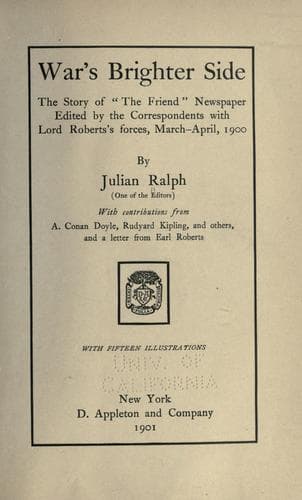
War's Brighter Side: The Story of The Friend Newspaper Edited by the Correspondents with Lord Roberts's Forces, March-April, 1900Ralph, Julian
History
War's Brighter Side: The Story of The Friend Newspaper Edited by the Correspondents with Lord Roberts's Forces, March-April, 1900
Ralph, Julian
Friend (Bloemfontein, South Africa); South African War, 1899-1902 -- Periodicals
It is impossible, in discussing the uses and abuses of any particular
arm, to dissociate that arm from the whole to which it belongs. A
complete modern force should consist of a proper proportion of horse,
foot, and artillery. The three form the whole, the perfect machine.
The parts must fit into each other as the cogs of one wheel fit into
those of another. In the war of the future infantry will be used for
two purposes--to contain the opposing infantry, and to hold positions
seized by the mobile portion of the force, be it cavalry or mounted
infantry. There will be very little preparation by the artillery for
infantry attack, for the simple reason that I am convinced that
frontal attacks are things of the past. Not the modernest of modern
artillery, lyddite, melinite, or whatever high explosive is used, can
by frontal concentration move or weaken infantry sufficiently to
destroy their defensive power against an infantry attack.
There will, therefore, be in the next war between European or
civilised military Powers grand artillery duels between the opposing
artillery, while the mounted force of one is trying to outflank the
other. The obvious necessity, therefore, is the highest development
of the most mobile portion of the artillery--the R.H.A. Flank
movements must necessarily be the tactics of the future. Battles will
be, as they always have been, won by strategy, but for modern strategy
and modern tactics the great necessity will be the greatest mobility
of the greatest force. But the British Army, as it certainly possesses
the finest material for infantry in the world, also possesses, I feel
sure, as fine an artillery as any. I am not talking now of guns, but
of the men who work them. In attempting to outflank an enemy with the
mobile portion of his force, the general of the next war will find his
flanking movement met by the mobile portion of his opponent's army.
The result is to be either a return to the old cavalry charges against
cavalry or an artillery duel. The latter, I believe, will be the case.
The cavalry of the future will be a mixture of the mounted infantry
men and the cavalry men, and as such will be able to stop with rifle
fire any attempts at the old-fashioned charge, and the verdict will be
pronounced by the gunners. Then, indeed, will the better-trained,
better-equipped, better-handled horse artillery be able either to
drive back the attack and so save the whole situation, or to force in
the defence and win the whole battle. Wherefore it would appear to me
that we should improve and improve our horse artillery until we have
the best guns, the best gunners, and the best organisation in the
world. I know we have the best material.
Public-domain text, read in full here on John Shaqi.
Reviews
Reviews
No reviews yet
Be the first to share your thoughts on this work.
Elsewhere in the archive
Join the Discussion
Join the discussion
Sign in to leave a comment or review.
Sign InorCreate an account