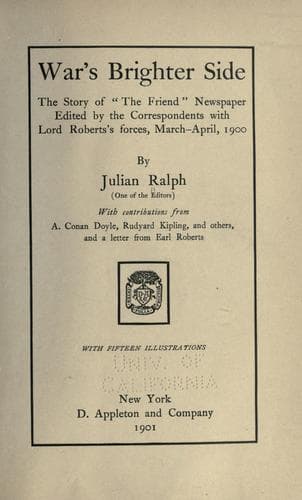
War's Brighter Side: The Story of The Friend Newspaper Edited by the Correspondents with Lord Roberts's Forces, March-April, 1900Ralph, Julian
History
War's Brighter Side: The Story of The Friend Newspaper Edited by the Correspondents with Lord Roberts's Forces, March-April, 1900
Ralph, Julian
Friend (Bloemfontein, South Africa); South African War, 1899-1902 -- Periodicals
In the shops we found a wall of soldiers before every counter. They
were in swarms like flies in all except the drinking places. There
they could not go; poor fellows, to whom a drink would have seemed so
much more than to us, who could have it whenever and wherever we
wanted it.
I will say again, here, as I have said elsewhere once before, that
though we underwent more danger than many of the soldiers (who were
not sent, as we were, into every battle), and though we endured
hardships sufficient to break many strong men, we correspondents had
this advantage over the rest--that, no matter how light was the
marching-kit ordered for the troops, we were usually followed by our
carts, and when these came up with us, we had abundance--and some
luxuries.
It was my good fortune to be able to replenish the larder of one
regiment more than once when, between battles, it entertained a
general or the Commander-in-Chief. We in Roberts's and Methuen's army,
were never criticised for living as well as we could, but there is a
story current in army and war correspondent circles to the effect that
the hero of Omdurman severely rebuked certain correspondents for
living on a scale which provoked the envy of the officers, and
demoralised them. One correspondent of the little mess that was thus
criticised--a man who drank very little himself--is said to have
utilised one camel solely to carry the champagne with which he
entertained his friends among the officers. I do not say what I might
have done had this story been told me earlier, but, as it was, I had
no camel, and the champagne that kind friends sent me from England
never reached me.
My stores consisted of poultry in tins, puddings, jams (how good those
Cape jams are, by the way; they should have a great sale in all
civilised parts), tinned vegetables, bully beef and bullier tongue and
ham, preserved fruits, biscuits, figs, cigarettes, cigars, and a
little most evanescent whisky.
But to get back to the streets of soldier-burdened Bloemfontein; how
surely, as we assembled in the corner by the office, did the soldiers
recognise their poet and friend. He looked at all of them in general,
but all of them stared at him in particular. They passed the word
from rank to rank, "There's Rudyard Kipling!" and then marched on,
leaving their eyes on his face while their bodies passed along, until
it looked as if they must dislocate their necks before they had their
fill of seeing him.
He was like a comrade when he talked to a private, and talk to them he
did. Jack tar, Colonial, regular, and Pathan, he talked to all alike.
"How are you getting on? Is your camp all right? Near here? Where was
your last fight?" So he both introduced himself and set them talking
and at ease--all in a breath.
Public-domain text, read in full here on John Shaqi.
Reviews
Reviews
No reviews yet
Be the first to share your thoughts on this work.
Elsewhere in the archive
Join the Discussion
Join the discussion
Sign in to leave a comment or review.
Sign InorCreate an account