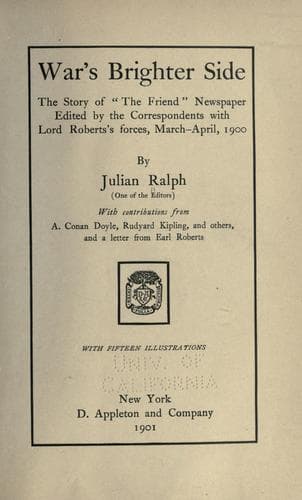
War's Brighter Side: The Story of The Friend Newspaper Edited by the Correspondents with Lord Roberts's Forces, March-April, 1900Ralph, Julian
History
War's Brighter Side: The Story of The Friend Newspaper Edited by the Correspondents with Lord Roberts's Forces, March-April, 1900
Ralph, Julian
Friend (Bloemfontein, South Africa); South African War, 1899-1902 -- Periodicals
But, as I have said, "Tommy" is inscrutable. I stepped one day into a
German tobacconist's across the street from, and farther along than,
the Club, and found it packed by soldiers who were being served by an
insolent German with a portrait of ex-President Steyn in his coat
lapel.
"Take that picture out of your button-hole," said I. "What do you mean
by wearing a thing like that when you are under British rule, and have
been both protected and generously treated?"
"I vill vear vot I shoose," said he.
I made a mental promise to see that he did not wear that emblem much
longer, and then turning to the soldiers I said, "Men, did you not see
what this man is wearing? Why do you spend your money on a man whose
sympathies are with the Boers? Give his shop the cold shoulder, and he
will soon see that he is making a mistake."
The appeal was in vain. The men instantly began to look very
uncomfortable. They rolled their eyes up to the ceiling or pinned
their gaze on the floor. No one said a word or even shot a glance of
approval in my direction. They did not care. Tommy does not
care--never cares--about anything, apparently.
I tried to keep my promise. Search was made for that tobacconist, but
he never served behind his counter after that visit of mine. He saved
the military the trouble of sending him to Capetown.
Lively days were those for rebels and irreconcilables. The men who had
most ardently furthered the cause of the Bond and the Transvaal war
party, and who had the indecency to loiter in the town, were quickly
weeded out and sent to the Boer prison camp near Capetown. If we could
not always tell who were our friends, these mischievous wretches were
worse off, for, ofttimes, their old neighbours, tired of the war and
awake to the folly of keeping it up, pointed them out to the military,
and retailed their nauseous histories.
"I feel a little like a lieutenant of Fouche," said one correspondent
to me. "I had pointed out to me a former editor of one of the local
papers whose pen was used with vitriol and who did as much as any man
to degrade and spoil this little country. I was told that he is still
talking angrily and abusively of us, and I was indignant. I mentioned
the case to a prominent military officer and in three hours the man
was a prisoner on his way to Capetown. I feel as if I was living in
Paris in the French revolution--very creepy and uncomfortable. I shall
keep my discoveries of such rascals to myself after this."
Public-domain text, read in full here on John Shaqi.
Reviews
Reviews
No reviews yet
Be the first to share your thoughts on this work.
Elsewhere in the archive
Join the Discussion
Join the discussion
Sign in to leave a comment or review.
Sign InorCreate an account