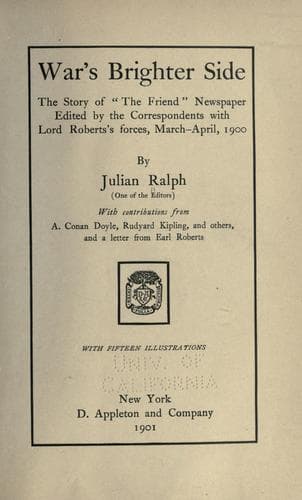
War's Brighter Side: The Story of The Friend Newspaper Edited by the Correspondents with Lord Roberts's Forces, March-April, 1900Ralph, Julian
History
War's Brighter Side: The Story of The Friend Newspaper Edited by the Correspondents with Lord Roberts's Forces, March-April, 1900
Ralph, Julian
Friend (Bloemfontein, South Africa); South African War, 1899-1902 -- Periodicals
On the afternoon of Monday, the 26th February, the 6-in. howitzers
bombarded Gen. Cronje's laager at Paardeberg with Lyddite shells. The
effect of the salvos viewed from a distance of 3,000 yards was
terrific. What the occupants of the laager felt cannot be told, for
the reason that no truthful account is obtainable. The explosions in
appearance were not unlike the great dynamite explosion in
Johannesburg in 1896, only the great cloud of smoke was
greenish-yellow instead of grey. An air of expectancy pervaded the
British camp, every one knowing that the morrow was Majuba Day, and it
was thought that something decisive would be done. Early next morning,
about 3 o'clock, the silence of the night was broken by the softened
spit-puff sound of the Mauser rifle, and immediately after the firing
became a fierce fusillade, the sharp crack of the Lee-Metford joining
in. The crackling concert lasted about an hour, rising and falling
with sudden acute crises like a passage of Wagner's music. Bullets
were falling around the camp at distances up to 3,000 yards, from the
Boer laager, and it was evident that the firing was wild.
At first streak of dawn a ride to the advanced trenches of the
Canadians on the river bank enabled one to learn the wherefore of the
night's disturbance. The ambulance waggons were already proceeding
quickly up the south bank of the river. A pontoon ferry was plying
from bank to bank bringing across wounded Canadians, nearly all
suffering from bullet wounds, but some few had by accident been struck
by the bayonet.
The Canadians occupied trenches on the both banks of the river, and
were within about 500 yards of the enemy. On their left--that is some
distance north of the river--were the Gordons, and further to the
south the Shropshires. The orders were that the four companies of
Canadians on the north bank should advance under cover of the darkness
and try to gain the enemy's trenches, or at least get nearer. They
advanced in two lines of two companies each, the front line having
bayonets fixed and the second carrying rifles slung with picks and
shovels in their hands to dig an advanced trench, should it be thought
advisable to go right to the trenches.
Public-domain text, read in full here on John Shaqi.
Reviews
Reviews
No reviews yet
Be the first to share your thoughts on this work.
Join the Discussion
Join the discussion
Sign in to leave a comment or review.
Sign InorCreate an account