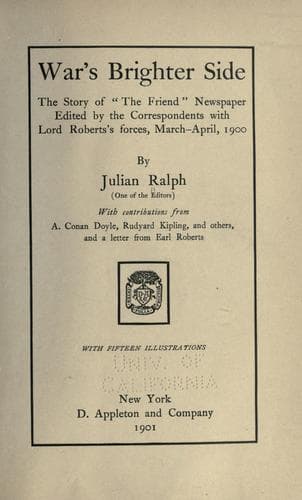
War's Brighter Side: The Story of The Friend Newspaper Edited by the Correspondents with Lord Roberts's Forces, March-April, 1900Ralph, Julian
History
War's Brighter Side: The Story of The Friend Newspaper Edited by the Correspondents with Lord Roberts's Forces, March-April, 1900
Ralph, Julian
Friend (Bloemfontein, South Africa); South African War, 1899-1902 -- Periodicals
They are mostly obtained out of cities and towns, which leaves much to
be wished for in their clearness of sight, steadiness of arm, and
power of self-reliance, while the discipline, organisation, rules and
directions to which they must hold weaken them more, so that they are
merely tools, standing under their officers' commands, of a fighting
machine. The officers in many instances are young and without
experience, and mentally and bodily unfit to fulfil their serious and
responsible duties, chosen to be officers not for their ability, or
natural talent, but because they are sons of the noble, or of the
respected of the land.
It is, however, not intended here, by any means, to throw the blame on
the valour of the officers or men.
When the nature of both armies is considered, one comes to the
conclusion that the British troops all gain an advantage in an attack
on equal ground, if a strong force is used in it, while the Boers will
obtain one in case there are fewer attackers brought into the field.
The English will benefit by defending, especially if time be given
them to build defences, and also where towns and camps must be held.
Over hilly and uneven ground the Boer has by far the best chance to
attack, while in an eventual defence he has everything in his favour,
and is practically not to be got at.
The British authorities have apparently too much trust in the result
of their Artillery. It is plain that they cherish the idea that it
will have a demoralising effect on the Boers, and therein they have
fortunately been mistaken. They did not calculate that the effect
could not be so great on scattered troops, and that the result cannot
be equal to the expenditure and difficulties of transport. On the
other hand, the Artillery of the Boers necessarily has a powerful
result on troops which, like the British, are formed in close order,
notwithstanding, according to the ideas of the writer of this, enough
use is not made of "black gunpowder" with a view to find the distances
by trial shots with that powder, to be afterwards followed by
burstable shells with "time fuse" to produce great destruction.
As the ground is mostly soft, shells which burst on impact, so-called
percussion shells, cannot mostly be used with favourable results,
except under special circumstances. To bombard camps or towns
"cordite" or "melanite" should not be used, as both explosives contain
no inflammable properties, which are so necessary to set houses,
waggons, forage, &c., on fire.
The greatest care should be taken that the mounted Boers should not be
exposed in the open plain to the attacks of the enemy's cavalry,
unless they are protected by quick-firing Maxim-Vickers guns and
shells, seeing that the British Cavalry have a great advantage at
short distances in the use of lances, swords and pistols.
Public-domain text, read in full here on John Shaqi.
Reviews
Reviews
No reviews yet
Be the first to share your thoughts on this work.
Elsewhere in the archive
Join the Discussion
Join the discussion
Sign in to leave a comment or review.
Sign InorCreate an account