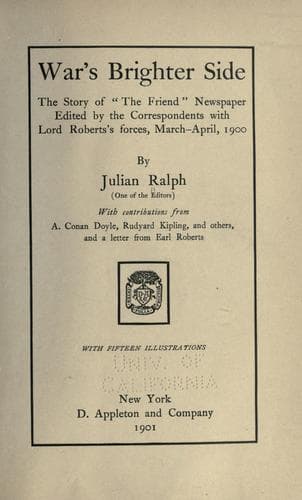
War's Brighter Side: The Story of The Friend Newspaper Edited by the Correspondents with Lord Roberts's Forces, March-April, 1900Ralph, Julian
History
War's Brighter Side: The Story of The Friend Newspaper Edited by the Correspondents with Lord Roberts's Forces, March-April, 1900
Ralph, Julian
Friend (Bloemfontein, South Africa); South African War, 1899-1902 -- Periodicals
Let us have the point at issue clearly defined. War correspondents are
with the army to report the war--some by word pictures, others by
camera or pencil pictures. Sight-seeing is a passion with humanity.
Every inhabitant of the British Isles would like to have a personal
vision of the conflict in South Africa, but--save for two or three
irresponsible persons whose presence at the front no one can
understand--those inhabitants are compelled to rely upon the eyes of
others. Now, leaving aside the correspondents who devote themselves to
word pictures solely, the question to be decided is--does the man with
the camera surpass the man with the pencil in depicting the actuality
of warfare?
An astounding claim is made on behalf of the man with the pencil. He
can, we are told by Mr. Wollen, show the public "an accurate
bird's-eye view of what a battle is like." And he does it by "a few
lines to indicate the background and characteristics of it." The same
authority assures us that "the brain of the camera cannot take in all
that is going on. The man with the pencil does so." Such is the case
for the man with the pencil. Now for the test of cross-examination.
Modder River and Maghersfontein may be cited as two representative
battles of the war, and so may be honestly used as touchstones to try
the claim Mr. Wollen makes on behalf of the man with a pencil. In each
case there was a battle-line of some five or six miles, in each case
the enemy was invisible, in each case it was physically impossible for
any one man to see more than a small portion of the battle. A
spectator on the right flank at Modder River could have no personal
knowledge of incidents which were happening in the centre of the
bridge, or down the river on the left flank. Even of his own
particular section on the right flank that spectator could not attain
to a perfect knowledge. But the man with a pencil is untrammelled by
such minor matters as time and space; he "takes in all that is going
on." Or, if he does not take it all in, he puts it in his sketch. The
result is no more "an accurate bird's-eye view of what a battle is
like" than a photograph of Oom Paul is like a photograph of Mr.
Chamberlain. In short, the facility with which the pencil-man can jot
down what he did not see is his ruin.
Public-domain text, read in full here on John Shaqi.
Reviews
Reviews
No reviews yet
Be the first to share your thoughts on this work.
Elsewhere in the archive
Join the Discussion
Join the discussion
Sign in to leave a comment or review.
Sign InorCreate an account