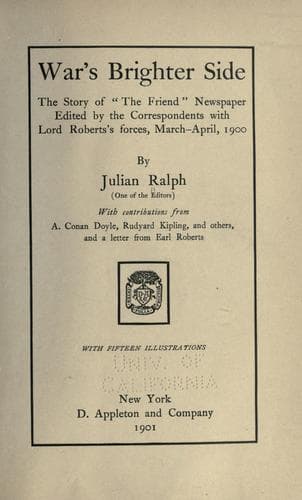
War's Brighter Side: The Story of The Friend Newspaper Edited by the Correspondents with Lord Roberts's Forces, March-April, 1900Ralph, Julian
History
War's Brighter Side: The Story of The Friend Newspaper Edited by the Correspondents with Lord Roberts's Forces, March-April, 1900
Ralph, Julian
Friend (Bloemfontein, South Africa); South African War, 1899-1902 -- Periodicals
It will be obvious that the man with the pencil, not being ubiquitous,
_cannot_ "take in" all that happens on a battlefield; he sees just as
much as, and no more than, the man with the camera; for the
rest--which forms so large a proportion of his sketch--he has to rely
upon the testimony of others. Now, when the public have in their hands
a result attained by this method, what is its value as an "accurate
bird's-eye view of what a battle is like?" Absolutely _nil_. People at
home want to see a battle as they would have seen it if they had been
present, and no sane man will contest the assertion that the best
medium for giving them that vision is the camera rather than the
pencil. Try as he may after the actual, the man with the pencil
thrusts his personality between the event he sees and the people at
home for whom he wishes to reproduce it, and consequently his sketch
becomes a miserable failure when considered as an "accurate bird's-eye
view of what a battle is like."
On the other hand, what does the man with the camera do? He and his
lens see at least so much of a given battle as any man with a pencil,
and what they see they see with unfailing accuracy. Take that battery
in action which Mr. Wollen choses to cite as a subject wherein the
powerlessness of the camera is supposed to be illustrated. The camera
man does not fear the test. He can show the guns coming into action,
record their unlimbering, depict the preparation for firing, and time
a photograph at the actual moment of firing. It is true that his
picture will not show quite such a volume of smoke as the sketch of
the man with the pencil. But why? _Because the smoke is not there._
The man with the pencil puts it in because other men with pencils have
been putting it in for generations. Perhaps, too, the public would not
mistake the sketch for a battle-scene if the smoke were absent.
Anyhow, what becomes of the boast of _accuracy_? Moreover, the man
with a camera will not present his public with a twelve-pounder firing
from the carriage of a howitzer.
There is something more to be said for the man with a camera.
Now-a-days he is in the habit of screwing a telephoto lens to the
front of the camera, and with that lens he can immensely outdistance
the vision of even that all-seeing man with the pencil. Objects a
couple of miles off are brought near, and groups of men can be
photographed at such distances as prevent them assuming any posing
attitudes. In this way actuality takes on the added charm of natural
grouping, and I shall be greatly surprised if some of the telephoto
pictures of this war do not take rank as the most artistic as well as
realistic records of its incidents.
Public-domain text, read in full here on John Shaqi.
Reviews
Reviews
No reviews yet
Be the first to share your thoughts on this work.
Elsewhere in the archive
Join the Discussion
Join the discussion
Sign in to leave a comment or review.
Sign InorCreate an account