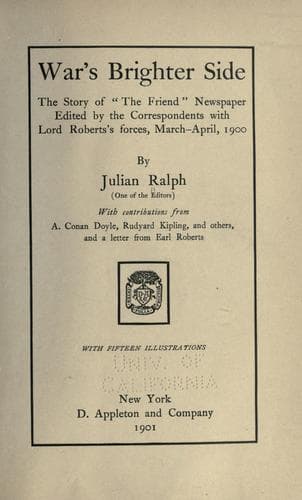
War's Brighter Side: The Story of The Friend Newspaper Edited by the Correspondents with Lord Roberts's Forces, March-April, 1900Ralph, Julian
History
War's Brighter Side: The Story of The Friend Newspaper Edited by the Correspondents with Lord Roberts's Forces, March-April, 1900
Ralph, Julian
Friend (Bloemfontein, South Africa); South African War, 1899-1902 -- Periodicals
subsequently that the messenger despatched for assistance, as well as
two others who followed him, were captured. The correspondents state
that the skill displayed by their drivers in avoiding the huge
boulders which lined the high road, and especially in descending and
ascending the banks of a very precipitous sluit with a twelve feet
dip, was a most creditable performance, reminding one of the wonderful
exercises of our artillery drivers at the Islington Military
Tournament.
* * * * *
CORRESPONDENCE.
CANADIANS ON MAJUBA DAY.
BY MAJOR-GENERAL SMITH-DORRIEN.
BLOEMFONTEIN, _March_ 17, 1900.
_To the Editor of_ "THE FRIEND."
DEAR SIR,--I have read your account of "The Canadians on Majuba Day"
in your issue of yesterday. It is correct up to a certain point, but
the last part of it is quite erroneous.
In justice to this gallant corps, and to the Company of Royal
Engineers who were with them, I trust you will publish this
letter--which recounts what actually happened from the moment the
Royal Canadians advanced from the trench, 550 yards from the enemy,
until they established themselves and made a new trench within 93
yards of the Boer trenches.
At 2.15 a.m. (on the 27th February), the Royal Canadians with 240 men
in the front rank, the latter with rifles slung and entrenching tools,
and about 30 officers and men, Royal Engineers under Lieut.-Colonel
Kincaid forming the right of the rear rank of the Canadians, moved
steadily from the trench, shoulder to shoulder in the dark night,
feeling their way through the bushes, and keeping touch by the right.
At 2.50 a.m. they were met by a terrific fire from the enemy's trench,
now only 60 yards in front of them.
The line was forced to fall back, but only a very small distance, the
right of it under Captains Stairs and Macdonell, Royal Canadians, some
twenty yards, where they lay down in the open and returned a steady
fire--mostly volleys--for the next one and a half hours; the left had
had to fall back rather further.
Under cover of these two Captains, Lieutenant-Colonel Kincaid and his
R.E. officer and men, and the Canadian working party in that part of
the line constructed trenches in spite of the galling fire, and by
daylight had completed a most admirable work which gave grand cover
against fire in all threatened directions, and was so well traversed
with banks and sand-bags that not a single casualty occurred after it
was occupied.
As day dawned a ruined house was noticed on the opposite bank of the
river, from which this work could be enfiladed, and a party from the
reserve was sent up the left bank to occupy it.
To cover the early morning attack as soon as the fire opened at 2.50
a.m., the Shropshires, in order to hold the enemy in the main laager,
engaged them with long-range volleys, whilst the Gordons remained
partly in the open and partly in the most advanced flank trench, which
latter they lengthened and enlarged, ready to move forward in support.
Public-domain text, read in full here on John Shaqi.
Reviews
Reviews
No reviews yet
Be the first to share your thoughts on this work.
Join the Discussion
Join the discussion
Sign in to leave a comment or review.
Sign InorCreate an account