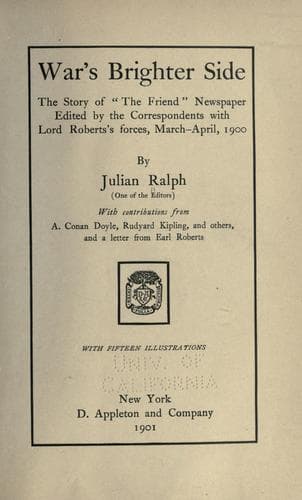
War's Brighter Side: The Story of The Friend Newspaper Edited by the Correspondents with Lord Roberts's Forces, March-April, 1900Ralph, Julian
History
War's Brighter Side: The Story of The Friend Newspaper Edited by the Correspondents with Lord Roberts's Forces, March-April, 1900
Ralph, Julian
Friend (Bloemfontein, South Africa); South African War, 1899-1902 -- Periodicals
Well, that's why we don't say what Regiment we belong to. But just to
give the devil his jew we don't see why General French gets all the
telegrams from the Queen and Lord Mayors--and we ain't even had our
chocolate served out yet.
But this is the truth--Billy and the Yank'll both swear to it.
Yours truly,
NUMBER ONE.
* * * * *
IS THE ART OF WAR REVOLUTIONISED?
BY H. A. GWYNNE.
1.--_Infantry._
Since the days of bows and arrows the art of war has been gradually
developing. The arquebus followed the silent bow, and perhaps it may
be said that this change was the most revolutionary change ever
experienced in the history of warfare. But the arquebus could not
effectively prevent the opposing forces from coming to close quarters,
and therefore the strong man with a thorough knowledge of the use of
the _arme blanche_--be it pike, sword, or spear--was the mainstay of
their armies. With the successive introduction of the matchlock, Brown
Bess, and the host of old muzzle-loading rifles, up to the time when
the Snider rifle came into use, still the same conditions of fighting
remained. By the same conditions I mean the following:--
(1) The enemy, when firing at an effective range, was visible to the
naked eye of his opponent.
(2) Even when concealed behind cover the smoke of his rifle easily
disclosed his position.
(3) Neither the accuracy nor the rapidity of fire was sufficient to
make an attack across open ground by a slightly superior force
impossible.
The introduction of the Martini-Henry completely altered at least the
third of these conditions, but owing to the fact that no European war
of great importance was fought with Martini-Henrys, the change was not
brought home to military theorists. It is true that the Turks fought
the Greeks with the Martini and the Gras rifles, but the war was not
serious, and the Greeks never held even their entrenched positions
with sufficient tenacity to bring home to the world the fact that an
advance across the open towards an enemy under cover was becoming more
and more impossible.
But smokeless powder and the long range rifle brought with them
changes which do not appear to be properly understood. In the first
place, it may be laid down as an axiom of warfare that the area of
effective rifle fire (and indeed of any fire) is restricted by the
areas of vision. During the present war it has become evident to those
who have studied the question, that the dangerous zone of fire with
modern rifles is not, as was at first supposed, within the 1,000 yards
range, but within 1,500 or even 1,600 yards.
Public-domain text, read in full here on John Shaqi.
Reviews
Reviews
No reviews yet
Be the first to share your thoughts on this work.
Elsewhere in the archive
Join the Discussion
Join the discussion
Sign in to leave a comment or review.
Sign InorCreate an account