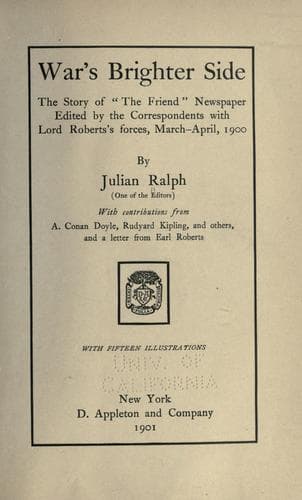
War's Brighter Side: The Story of The Friend Newspaper Edited by the Correspondents with Lord Roberts's Forces, March-April, 1900Ralph, Julian
History
War's Brighter Side: The Story of The Friend Newspaper Edited by the Correspondents with Lord Roberts's Forces, March-April, 1900
Ralph, Julian
Friend (Bloemfontein, South Africa); South African War, 1899-1902 -- Periodicals
To advance in the open against an enemy, even when that enemy is not
under cover but simply lying on the ground, involves one of two
alternatives. Either the advancing force is annihilated by the time it
gets to within 500 yards of the enemy, or it is forced to lie down
1,500 yards away or less and return the enemy's fire. But the latter
alternative produces a state of things which has never been known in
the history of war. Both the advancing and the expectant forces are
put out of action. Neither can advance and, what is more serious
still, neither can _retire_.
This contingency opened up an entirely new field of tactics. The
general who can, with a smaller force, succeed in putting out of
action, at least for the time being, a greater force of his opponent,
is more likely to win his battle. In the future, the curious sight
will be seen of regiments or even brigades lying flat on the ground,
doing little damage to the enemy and suffering little loss, and yet
being as useless to their general as if they were snoring in their
barracks at home. Perhaps this is too sweeping, for their presence in
front of the enemy will have the advantage of containing him, but in
the open, across which an enemy has to advance, a containing force of
a proportion of one man to five of the enemy is quite sufficient.
Therefore the use of a brigade to contain a brigade would be a waste
of material. Even those of us who have followed closely and carefully
all the stages of the campaign do not yet perceive the magnitude of
the changes involved by the use of modern rifles, but they appear to
me to be so radical that instead of describing them as fresh
developments, I would prefer to give an affirmative answer to the
title of this article.
But there yet remains to be discussed the question of the _arme
blanche_--the bayonet, the weapon with which our gallant army has won
so many of its victories. I have heard not a few officers declare that
this war will be known in history as the last war in which a British
soldier carried a bayonet. But is the discarding of the bayonet to be
one of the results of the use of the new rifle and the smokeless
powder? When fighting against an enemy who does not carry it, the
force which is armed with a bayonet has a tremendous moral
superiority. In the present war, there have been one or two
cases--one, particularly, at Slingersfontein--where the Boer has made
a frontal attack on a prepared position held by us. The attacks have
always been made along the tops of kopjes which afforded excellent
cover for a stealthy advance. The obvious way to meet such attacks was
to wait until the enemy came close enough to allow the use of the
bayonet, and this was done with great success at Slingersfontein. So
that it may be laid down that in cases where one only of two opposing
forces is armed with the bayonet, it is obviously to its advantage
that the enemy should in attacking come to close quarters.
Public-domain text, read in full here on John Shaqi.
Reviews
Reviews
No reviews yet
Be the first to share your thoughts on this work.
Elsewhere in the archive
Join the Discussion
Join the discussion
Sign in to leave a comment or review.
Sign InorCreate an account