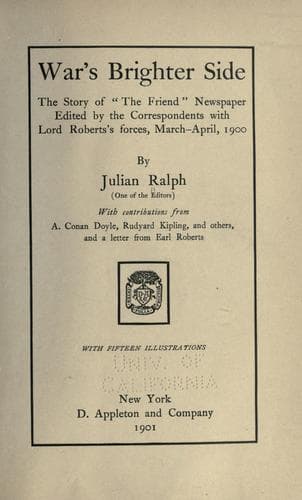
War's Brighter Side: The Story of The Friend Newspaper Edited by the Correspondents with Lord Roberts's Forces, March-April, 1900Ralph, Julian
History
War's Brighter Side: The Story of The Friend Newspaper Edited by the Correspondents with Lord Roberts's Forces, March-April, 1900
Ralph, Julian
Friend (Bloemfontein, South Africa); South African War, 1899-1902 -- Periodicals
It is, equally, to the manifest advantage of the defending force, if
unarmed with the bayonet, to prevent, with heavy rifle fire, the
enemy from being able to use the bayonet. But in my humble opinion,
the bayonet will not be discarded for a long time. In the first place,
the best tactician in the world cannot always prevent, even with
modern rifles, such things as surprises, and small bodies of men might
still, even under the new conditions, be able to get unperceived into
close quarters with the enemy. But the greatest reason for its
retention is that night attacks are still possible, and in night
attacks the bayonet is undoubtedly the weapon to be used. The very
mention, however, of night attacks opens up a long vista of discussion
and arguments which I do not wish to raise. I am aware that there are
many prominent soldiers who will have nothing to say to night attacks
and condemn them lock, stock and barrel, but they can never be
eliminated from the already long list of the contingencies of warfare.
Until something is mooted which will render night attacks absolutely
impossible, so long will the bayonet be retained.
But perhaps the most radical changes effected by the use of the long
range rifle will be in purely regimental organisation. A company now
extends for the attack over a space of over half a mile. The ordinary
complement of officers assigned to a company can never hope to control
the whole of it. What is the remedy? And how are we to bring up
ammunition to the firing line, or carry away our wounded from it? Can
a regiment extended for the attack eight paces apart act as a
regiment, or in the future is the company to be the biggest infantry
unit in action? All these questions spring from the experiences of the
present campaign, and it is to be hoped that they will be answered by
those whose experience in the many engagements against the enemy will
give value and force to their words.
* * * * *
FROM ENSLIN TO BOBSFONTEIN.
BY H. PREVOST BATTERSBY.
Received orders at 10 a.m. to proceed at once to Ram Dam and to join
the main column as soon as possible. Requisitioned for transport
immediately and supplied at 6 p.m. with about four dozen small
dilapidated hair trunks, misnamed mules, which looked as if they
required three square meals rolled into one, and a fortnight in bed!
No self-respecting cat would have looked at them twice, even cold on a
wooden skewer!
Public-domain text, read in full here on John Shaqi.
Reviews
Reviews
No reviews yet
Be the first to share your thoughts on this work.
Elsewhere in the archive
Join the Discussion
Join the discussion
Sign in to leave a comment or review.
Sign InorCreate an account