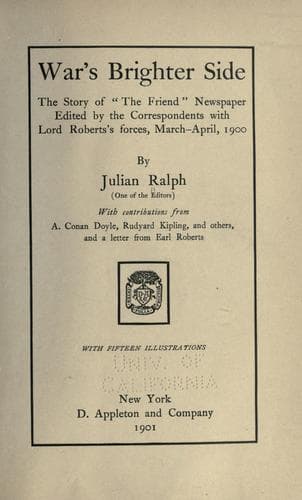
War's Brighter Side: The Story of The Friend Newspaper Edited by the Correspondents with Lord Roberts's Forces, March-April, 1900Ralph, Julian
History
War's Brighter Side: The Story of The Friend Newspaper Edited by the Correspondents with Lord Roberts's Forces, March-April, 1900
Ralph, Julian
Friend (Bloemfontein, South Africa); South African War, 1899-1902 -- Periodicals
Through war and pestilence, red siege and fire,
Silent and self-contained he drew his breath.
Too brave for show of courage--his desire
Truth as he saw it, even to the death.
RUDYARD KIPLING.
There is a pretty little cypress grove nestling under the shadow of
one of the Ladysmith defences. A peaceful oasis--green where the land
is parched and dry. It is God's acre. Before shaking the dust of
Ladysmith from off my feet for ever, I turned my pony's head towards
the green. The little animal seemed to know the way, and well he
should, for the melancholy journey to the cemetery had been frequent
during the latter period of the siege. I tied the pony to the rail and
passed in under the shadow of the cypresses. The interior of the
enclosure was one stretch of new-turned earth. The turf seemed all
exhausted. The dainty cemetery of three months ago had now the
appearance of a badly harrowed field. In places a rough cross marked
the last resting-place of the victims of war and pestilence, a few had
the names just scrawled upon a chip of wood; the majority lay
unnamed--the price of Empire keeping: a nameless grave!
I passed down the clay trodden pathway. The brief legends
ran--Egerton, Lafone, Watson, Field, Dalzel, Dick-Cunyngham, Digby
Jones, Adams--but why name them? They were all men whom three months
ago I had called my friends. Then I found the spot for which I
searched--a plain wooden cross inscribed G. W. Steevens, and a date.
What an end--six feet of Ladysmith's miserable soil! It was too cruel.
My memory carried me back to the brave companion and upright colleague
who was gone, and to the manner of his death--the man who had raced
with the Cameron Highlanders for Mahmoud's zareba; who had stood with
his hands in his pockets when it seemed that it must be but a matter
of minutes before Wad Helu swallowed up Macdonald's Soudanese brigade.
The man who had scorned death on Elandslaagte's crest lay there a
victim to pestilential Ladysmith. If the spare frame had been as stout
as the heart which it contained, that miserable rat-hole could not
have brought about the end. Poor Steevens--how he strove to live! For
a month he lay and fought the battle for life. And then when all
seemed well, and we looked for the day that we should have him back
again, he quietly faded under a relapse.
Doctors could do no more, and at four in the afternoon of the fatal
day it was evident that the end was near. Maud, who had nursed him
with a devotion unsurpassed, was deputed to break the news. He came to
the bedside and suggested that Steevens should dictate a wire to his
people at home. The patient looked up suddenly, and in a moment was
conscious of the sinister purport of the request. The conversation
which ensued was something of the following:--
"Is it the end?"
Maud nodded assent.
"Will it be soon?"
Again Maud nodded assent.
Public-domain text, read in full here on John Shaqi.
Reviews
Reviews
No reviews yet
Be the first to share your thoughts on this work.
Elsewhere in the archive
Join the Discussion
Join the discussion
Sign in to leave a comment or review.
Sign InorCreate an account